Signs of the Four Warehouse Bottlenecks
Exploring the four warehouse bottlenecks: receiving, inventory data, picking, and shipping. Here's how to reduce delays and error rates in daily operations.
Short Answer
Identifying the four warehouse bottlenecks—receiving, inventory data, picking, and shipping—can help reduce delays and errors in daily operations.
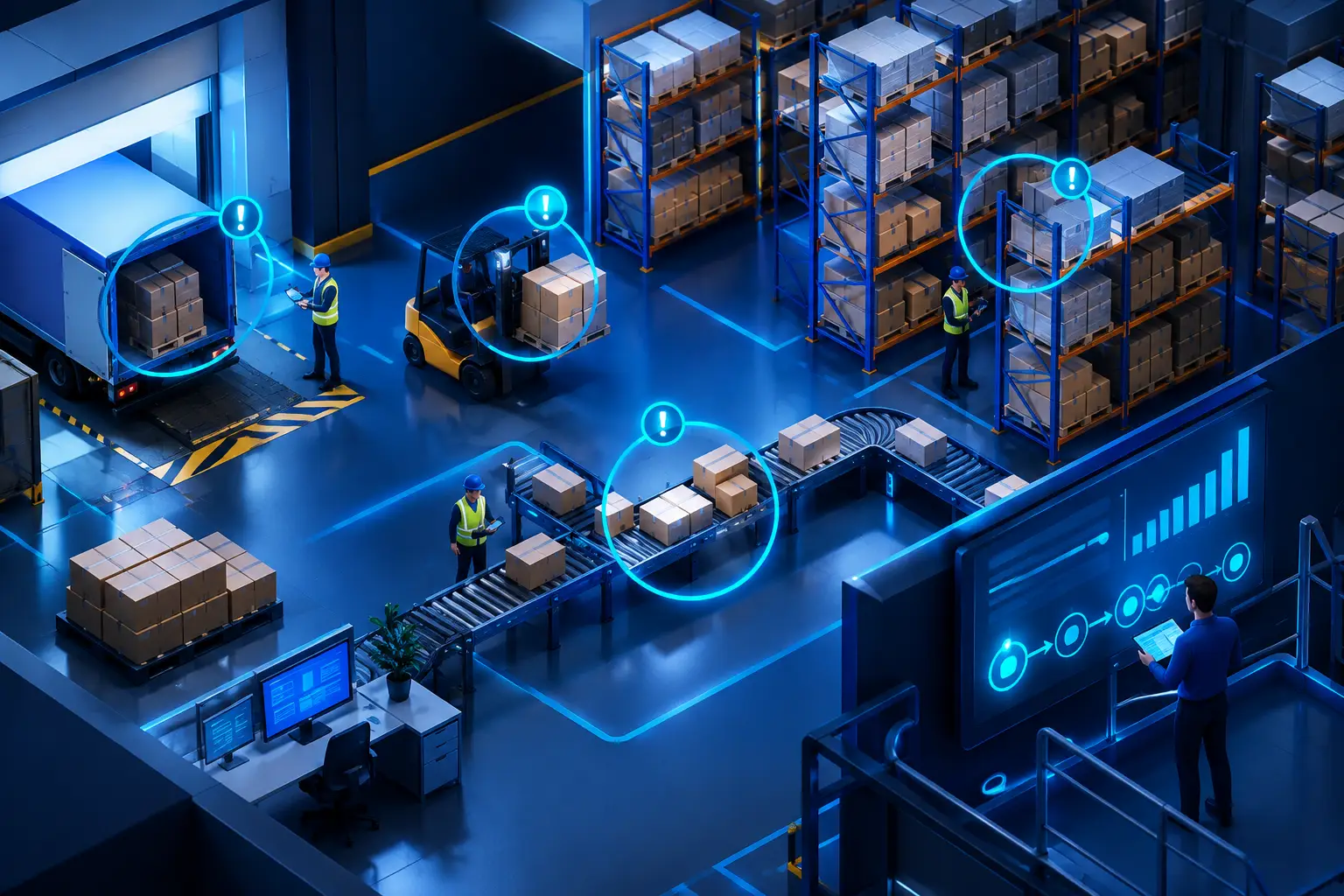
In the warehouse, everything seems manageable in the morning. However, by noon, incoming goods pile up, colleagues coordinate stock over the phone, pickers search for missing products, and the shipment is ready to go. The four warehouse bottlenecks are generally not a spectacular system failure. Rather, they are recurring situations that the team is accustomed to, and which demand more time, attention, and error correction day by day as traffic increases.
Warehouse performance does not solely depend on square footage, the number of shelves, or the number of employees. Often, the flow of information is slower than the goods themselves. A piece of data is entered into the system late, an order status is unclear, or an exception can only be handled by an experienced colleague. In such cases, the warehouse is not just busy: at some point, the process limits the entire company's operations.
The four warehouse bottlenecks
1. Receiving, which becomes visible too late
The goods have physically arrived, but they are not yet in stock in the system. This discrepancy can last for hours, sometimes days, in many organizations. The problem is particularly acute if sales, the webshop, or customer service already treat the product as available, while the warehouse has not yet checked, labeled, or placed it.
There are often perfectly understandable rules in the background. Quantity, damage, expiration, and supplier documents need to be checked. The issue is not the fact of the inspection, but if the process is fragmented across multiple people, on paper, via email, and in separate systems. For example, procurement knows about the expected delivery, the warehouse is only informed upon arrival, and finance receives the invoice later.
It is worth tracking the journey of a single pallet: who knows it is expected? Who records the arrival? When will it become sellable stock? Who decides on handling discrepancies? If there are no clear answers to these, the delay does not originate at the receiving point but earlier, at the information transfer stage.
Immediate stock entry is not always the right solution. For regulated products, quality control, or complex supplier discrepancies, a blocked status may be justified. The key is that this status should mean the same thing in all relevant systems and for all parties involved. Uncertain stock is worse than visibly unavailable stock.
2. Stock data that no one fully trusts
"In theory, we have it." This is one of the most expensive sentences in warehouse operations. If the recorded stock and physical stock regularly differ, the team builds its own verification processes around it. They make phone calls, maintain Excel sheets, set aside products, recount, or just ask for confirmation from a specific colleague.
These workarounds help serve the customer in the short term. In the long term, however, they obscure the real problem. Management sees that orders are eventually completed but does not see how much searching, coordination, correction, and unnecessary movement was involved.
There can be multiple reasons for stock inaccuracies: missing confirmations, unrecorded scrap, incorrect item master, unmanaged substitute products, delayed booked returns, or webshop orders whose stock reservations do not appear in time in the warehouse process. It is not advisable to assume that all discrepancies are due to human oversight. Often, the process itself makes errors likely because the same data must be manually recorded in multiple places.
Before finding a solution, it is necessary to clarify which system is the authoritative source for the given data. Where does the stock change originate? When is it transferred to another system? Who can amend it, and what trace does the modification leave? If these questions are unresolved, a new inventory management function may only spread uncertainty faster.
Picking is not just about the warehouse workers' pace
3. Picking, where searching has become part of the job
In picking, delays are often visible: long routes, colleagues turning back, incomplete lists, multiple checks. It's easy to conclude that more people or faster tools are needed. This is sometimes true, but not always the cause of the bottleneck.
If the order list does not contain reliable location data, if the product can be in multiple places, or if urgent orders continuously override the planned sequence, the picker is not picking but searching for information and handling exceptions. A similar situation occurs when sales modify an order afterward, but the change does not clearly reach the person who has already started among the shelves.
Here, it is worth distinguishing between genuine urgency and poorly visible priorities. An important customer's order may indeed take precedence. But if twenty orders a day are marked urgent, then it's not a priority system in operation but constant interruption. In such cases, workers respond to the loudest request, not the fulfillment deadline or the delivery plan.
When examining the process, it is necessary to measure how much time is spent on actual goods movement, searching, waiting, and error correction. This often yields surprising results. It may turn out that the picking capacity is not low, but a significant portion of the capacity is consumed by non-value-adding activities.
4. Packaging and shipping, where all errors arrive at once
At the end of the day, all previous uncertainties meet at the shipping point. An item is missing, the label does not match, the document needs reprinting, the data in the carrier's system differs, or an order is still not closable. The packaging area may easily seem like the problematic point, although it often only becomes visible here that the previous three phases had errors.
Late-arriving information is particularly costly. If the freight list, order status, and the actually prepared goods differ, colleagues try to coordinate before the closing deadline. This increases the risk of mislabeling, incomplete shipments, and incorrect billing. The customer perceives this as a delayed or faulty delivery, while the real cause may have originated at the morning's receipt.
In the packaging and shipping process, it is particularly useful to separate standard and exceptional cases. Which orders automatically move to the next step? Which require verification? What happens in case of an address error, partial delivery, or damaged goods? Exceptions cannot be completely eliminated, but they should not burden the normal process with the same manual coordination.
Start the improvement with the process, not the tool
The first step in addressing bottlenecks is not necessarily a new warehouse management system, barcode scanner, or automated workflow. First, the current operation must be precisely understood. It is worth following the path of an order, an incoming good, and a return from start to finish - including emails, spreadsheets, phone calls, and those decisions that are undocumented.
Then it can be determined which step is necessary, which repeats unnecessarily, where the same data is entered in multiple places, and where a person becomes the link between systems. In some cases, a clearer responsibility rule or unified status management brings the greatest result. In other cases, data connection between systems, a better item master, or exception handling support is justified. The appropriate technology can only be responsibly chosen after this.
A well-functioning warehouse is not good because there are never exceptions. It is good because exceptions are visible, manageable, and do not force the entire team into daily firefighting. When the warehouse process is built on reliable information, employees' time is not spent searching for shortages but on accurate order fulfillment and real decision-making.
Planning a similar system or integration?
Show us the current process and systems. We will help identify the lowest-risk next step.
Key Takeaways
- Identifying bottlenecks in receiving, inventory data, picking, and shipping is crucial.
- Addressing these bottlenecks can significantly reduce delays.
- Improving these areas can also lower error rates in operations.
- Efficient warehouse management enhances overall productivity.
- Proactive measures can prevent future bottlenecks.
Frequently Asked Questions
What are the four main warehouse bottlenecks?
The four main warehouse bottlenecks are receiving, inventory data, picking, and shipping.
How can addressing warehouse bottlenecks improve operations?
Addressing warehouse bottlenecks can reduce delays and error rates, leading to more efficient daily operations.
Why is it important to identify warehouse bottlenecks?
Identifying warehouse bottlenecks is important because it helps in implementing solutions that enhance productivity and operational efficiency.
Related Engineering Insights
How to Implement Document Processing?
How to implement document processing to reduce manual entry, improve data quality, and ensure long-term scalability of operations.
Establishing an Internal Approval Process
Establishing an internal approval process clarifies decision-making authority, reduces delays, and provides more reliable operations for a growing company today.
How to Assess Administrative Burdens?
Here's how we assess administrative burdens: we identify repetitive tasks, sources of errors, and processes that slow down growth precisely within the company.