Own Data Center or Hybrid Infrastructure?
Short Answer
Choosing between an own data center and hybrid infrastructure depends on business processes, risks, data management, and operational responsibilities.
A morning system outage is not primarily an IT problem. If the warehouse cannot see orders, production cannot access technical documentation, or billing stops, the downtime immediately becomes a business consequence. The question of whether to have an in-house data center or a hybrid infrastructure should not be decided based on servers, brands, or cloud trends, but rather on how the company actually operates.
A poor decision rarely becomes apparent on the first day. It gradually appears: more exceptions, uncertain backups, slow reports, difficult-to-track permissions, costly operations, or systems understood by only a few key people. Good infrastructure is not valuable in itself. It becomes valuable by reliably supporting daily operations, growth, and business continuity.
First, operational dependencies must be identified
Before considering what should remain on-premises and what should move to the cloud, it is worth reviewing which processes would halt in the event of a system outage. For an online store, this could be inventory information, order transfer to the warehouse, payment confirmation, or courier label generation. For a manufacturing company, production data, systems related to machinery, quality assurance documentation, or shift planning could be critical.
Not all data and applications require the same level of protection. Internal file sharing, an archived document repository, and a manufacturing management system operate with different availability, performance, and recovery expectations. If these are handled in a single technological decision, the environment often becomes either too expensive or too risky.
Management should pay particular attention to where there is hidden human dependency. If only one employee knows which server an old application runs on, how backups are made, or what needs to be restarted after an error, it is a business continuity risk. The same is true if a system appears to be working, but the documentation is incomplete, permissions are opaque, and recovery has never been tested in a real situation.
What does an in-house data center or hybrid infrastructure really mean?
An in-house data center does not necessarily mean a separate building and server room. It can be a server and network environment operating at a company site, managed or operated by the company. The advantage is that there is more direct control over the infrastructure, the physical location of data, and certain performance-critical systems.
This can be particularly justified where local industrial equipment, PLCs, SCADA systems, manufacturing equipment or applications requiring low latency operate. A production line cannot rely on all operational functions being available in the event of a brief remote connection interruption. Certain data protection, contractual, or client-side requirements can also strengthen the justification for local infrastructure.
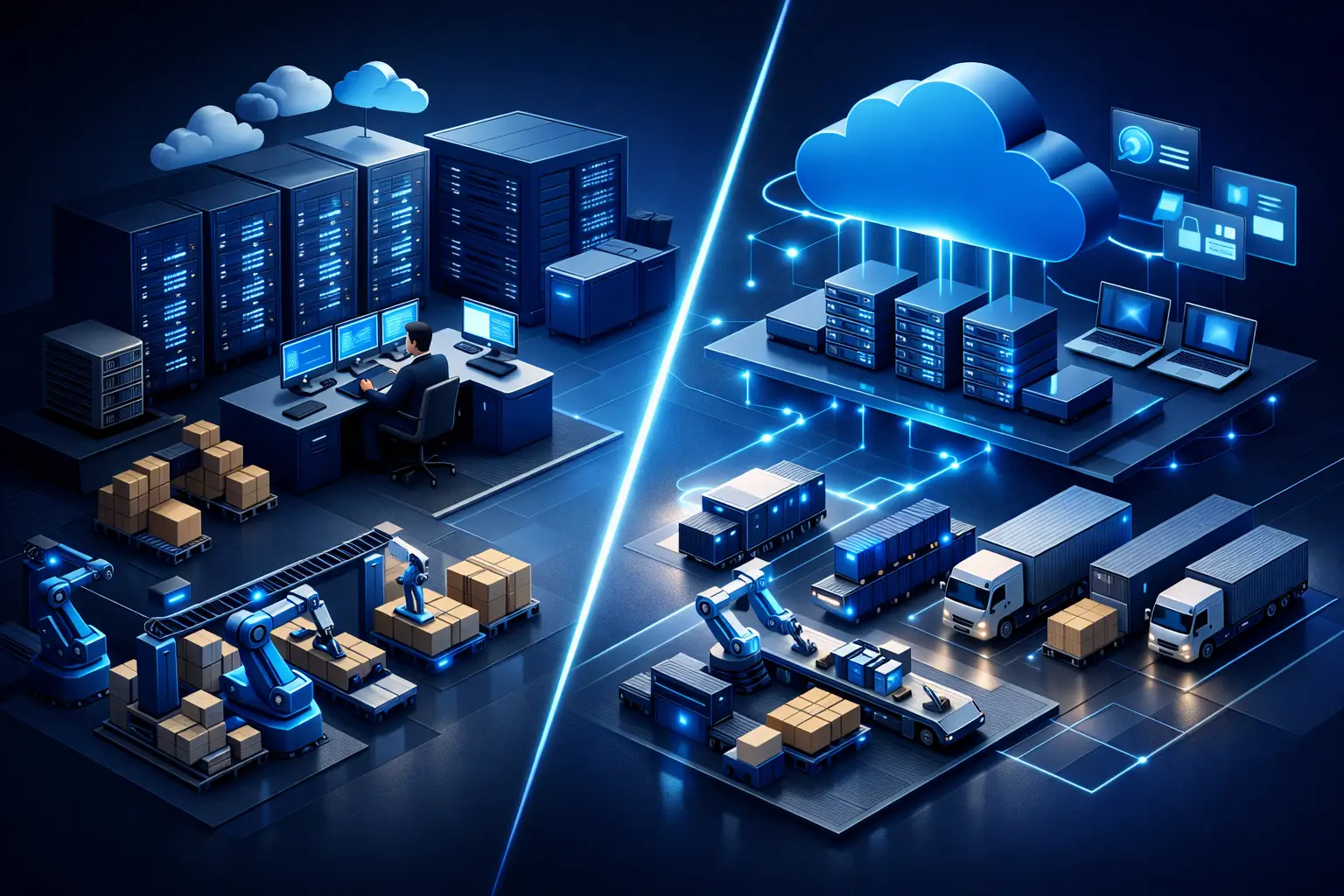
In contrast, hybrid infrastructure does not simply mean "there is a bit of cloud too." It means conscious distribution: some systems, data, or services remain on-premises, while others operate in a cloud environment. For example, the on-site production system and its cached data may remain local, while backups, reporting, client portals, development environments, or remote access services run in the cloud.
The model works well when it is clear why a component is in a given location, how it connects to others, who is responsible for its operation, and what happens in case of failure. Without this, a hybrid environment can easily inherit two types of problems: the limitations of local systems and the complexity of cloud services.
Control has a cost and a responsible party
Often, the argument for in-house infrastructure is control. This is a real advantage, but control does not just mean decision-making rights. It means managing the hardware lifecycle, capacity planning, updates, network protection, physical security, power supply, cooling, backup schedules, and continuous monitoring.
A server is not necessarily reliable just because it is new. If it has only one power supply route, no spare parts, the backup remains on the same site, or the recovery is not checked, even a minor event can lead to a longer downtime. In such cases, the main question is not the server's performance, but how quickly the company can restart critical operations.
Two useful business metrics are the recovery time objective and the acceptable data loss window. Simply put: how long can the process be down, and how much data loss is acceptable. A daily backup may be sufficient for a less critical document repository but unacceptable for an order management or production system where business transactions occur hourly.
Cloud components can reduce the burdens associated with local hardware, but they do not eliminate operational responsibility. Permissions, cost control, integrations, backups, logging, and access reviews still require managerial attention and professional responsibility.
Not every application needs to be moved to the same place
A complete move or keeping everything on-premises is often a false choice. A company's systems usually have different maturity levels, handle different data, and change at different business rhythms. For an old but stable production application, a quick transition might risk more than it gains. For a new client portal or reporting solution, a cloud service can offer more flexible startup and expansion.
The decision should be made on an application-by-application basis. Consider data sensitivity, related systems, performance requirements, regulatory requirements, required availability, frequency of changes, and actual operational costs. The latter is not just license or hardware costs. It includes internal work time, downtime costs, external expert dependency, and the risk of deferred modernization.
Integrations need to be handled with particular caution. If manual data movement already occurs between the online store, ERP, warehouse management, logistics and billing, an infrastructure change will not solve this by itself. In fact, if the process is flawed or opaque, the new technical environment will only carry forward the same error faster.
Typical operational advantages and limitations of the hybrid model
A well-designed hybrid environment is often practical because it does not force the company to replace all systems at once. It allows for gradual modernization while keeping critical local operations stable. The cloud can be suitable for isolated backups, business continuity reserves, analytical capacity, collaboration systems, or handling periodically increasing loads.
The limitations should be addressed just as clearly. In a hybrid system, the network connection becomes business-critical. Without proper redundancy, monitoring, and contingency plans, an internet connection failure can affect multiple services simultaneously. Identity and access management also becomes more complex: the same employee should not have multiple independent accounts with different accesses and an unmanageable exit process.
Costs also need to be continuously monitored. The cloud is not automatically cheaper, especially if capacity usage is not measured, data movement is significant, or temporarily created resources remain permanently on. The goal is not the lowest monthly bill, but a predictable, justifiable total lifecycle cost.
Decision-making process, not a one-time technology project
For a well-founded infrastructure decision, critical business processes, systems, and data flows must first be mapped. Then availability levels, recovery expectations, security requirements, and responsibilities can be determined. Only then can an architecture be built where local and cloud elements truly support each other.
Gradual implementation generally poses less risk than a single large transition. A well-defined service, such as the backup environment, an internal reporting system, or a new customer relationship application, can be a good starting point. Based on experiences, operational rules, access, costs, and support processes can be clarified before the company's more critical systems follow.
The right question is not whether an in-house data center or hybrid infrastructure is more modern. The question is which setup makes the work from order to fulfillment, from production to billing more predictable, and which makes the next growth phase manageable. If this answer is derived from processes, risks, and actual operational responsibilities, the infrastructure will not be a limitation but a reliable operational foundation.
Planning a similar system or integration?
Show us the current process and systems. We will help identify the lowest-risk next step.
Related Engineering Insights
What Limits Production Capacity?
Production capacity is not just a matter of machinery. Identify hidden process constraints that cause delays, errors, and overtime.
Corporate Reporting Tools for Better Decision-Making
Corporate reporting tools are effective when they are based on reliable data, clear accountability, and real business questions in daily practice.
Who is Responsible for Data Quality in the Company?
Who is responsible for data quality in the company? Roles, rules, and effective processes are needed for accurate reports and decisions in daily work.