Cloud vs On-Premises Infrastructure
A production line stoppage, an ERP delay, or a warehouse integration error is not a theoretical IT issue. In such situations, the cloud vs on-premises infrastructure debate quickly becomes a matter of business continuity, compliance, and governance.
Short Answer
A production line stoppage, an ERP delay, or a warehouse integration error is not a theoretical IT issue. In such situations, the cloud vs on-premises infrastructure debate quickly becomes a matter of business continuity, compliance, and governance.
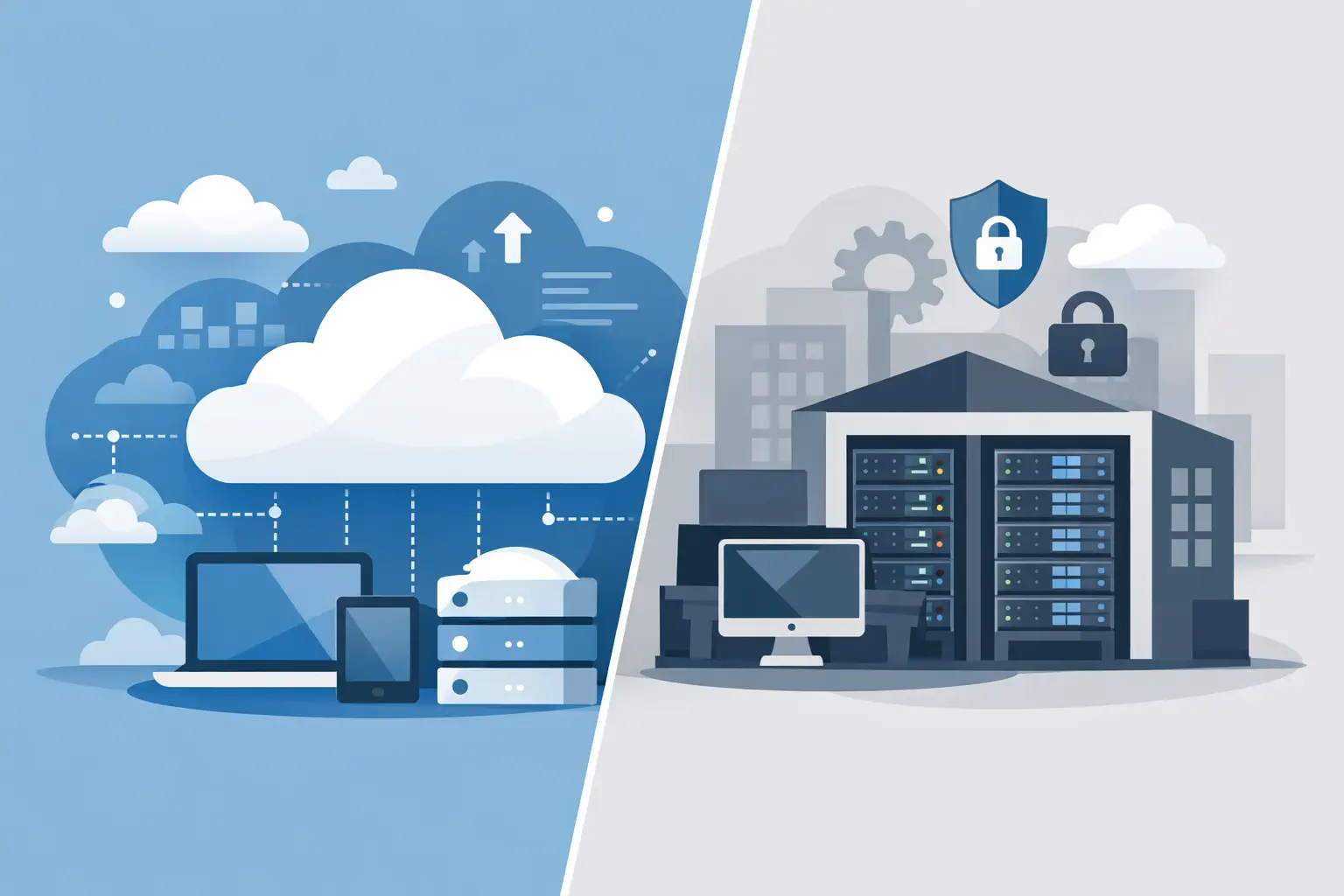
A production line shutdown, an ERP delay, or a warehouse integration failure is not a theoretical IT issue. In such situations, the cloud vs on-premises infrastructure debate quickly becomes a matter of business continuity, compliance, and governance. The real decision is not about which model is more modern, but which one better aligns with system criticality, risk profile, and operational discipline.
Cloud vs On-Premises Infrastructure from an Enterprise Perspective
The comparison between cloud and on-premises infrastructure often appears oversimplified in many organizations. Cloud is associated with flexibility, rapid deployment, and scalability, while the on-premises model is linked with control, predictability, and physical proximity. These statements are partly true but are not sufficient on their own for a good decision.
In corporate and industrial environments, the question is more about where the necessary availability can be ensured, where governance can be consistently enforced, and which model better supports the dependencies between business and operational systems. An e-commerce platform, a WMS, a production control system, and an ERP are not separate technological elements. They are parts of the same operational chain. If the infrastructure decision does not serve this chain, even a seemingly modern architecture can become vulnerable.
When Cloud is a Strong Choice
Cloud performs well when the load is fluctuating, the service is geographically distributed, or the rapid expansion of services provides a business advantage. For digital platforms serving multiple sites, client-side applications, and development environments, the cloud often offers shorter deployment times and more flexible capacity management.
Cloud can also be particularly useful when an organization needs standardizable infrastructure elements and can maturely manage automation, identity governance, logging, and cost control. In this case, the cloud is not just a hosting model but a regulated platform.
However, cloud does not equate to less responsibility for the company. While the service provider manages part of the physical infrastructure, architecture, access management, data flow, backup logic, network separation, and recovery scenarios are still decided on the client side. In many risky environments, the problem arises from the organization interpreting the move to the cloud as outsourcing rather than a different type of engineering responsibility.
When On-Premises Infrastructure Remains Justified
The strength of the on-premises model is most evident where latency, data localization, proximity to equipment, or regulatory control is primary. In industrial automation, production management, local data processing, systems using special interfaces, and strict audit requirements, on-premises infrastructure is often not a legacy but a conscious architectural decision.
This is especially true if the system must operate with weak or variable WAN connections or if downtime tolerance is minimal. In a warehouse, plant, or logistics hub, it is not always acceptable for all business processes to depend on the availability of central services. In such cases, the on-premises environment protects local autonomy and deterministic operation.
Another common reason is compliance. In some organizations, direct technical and organizational control over certain data is a requirement, not a preference. Not because the cloud is inherently less secure, but because auditability, contractual risk, data handling boundaries, and operational responsibility collectively justify it.
Cost is Not Simply CAPEX or OPEX
One of the weakest points in the cloud vs on-premises infrastructure comparison is the simplification of costs. It is often claimed that cloud is cheaper because there is no large initial investment, while on-premises is more expensive because hardware must be purchased. This is a too narrow financial perspective.
Cloud costs can be advantageous if capacity demand is variable, utilization is periodic, and resources can be managed automatically. But if a system runs continuously under high load, with large data movement, constant storage needs, and complex network traffic, the monthly cost can easily exceed the total cost of ownership of a well-designed local infrastructure.
On the on-premises side, it's not just the server price that matters. Redundancy, power supply, cooling, physical security, lifecycle management, spare parts, platform-level monitoring, and competent operational presence must be priced. Anyone who compares only based on purchase price is almost certainly making a wrong decision.
The correct cost model examines what business process the infrastructure protects, the cost of downtime, and the cost of lack of control. In many companies, the largest item is not the monthly infrastructure fee, but the operational disruption, integration error, or audit deviation caused by a poorly chosen platform.
Security and Governance: The Platform Alone Does Not Decide
Debates about security often occur on ideological grounds. Some say the cloud is inherently more secure, while others claim only on-premises provides real control. Both statements are misleading.
The actual level of security is not determined solely by the hosting model but by the discipline of the architecture. If access management is loose, network segments are not clearly separated, backups are not tested, or change management is ad hoc, then both models are vulnerable.
In cloud environments, the risk often arises from building too quickly. It's easy to create new resources, but just as easy to proliferate exceptions, orphan components, and undocumented connections without control. In on-premises environments, the risk often comes from slowly accumulating technical debt, manual configurations, and operational practices developed over years that are difficult to audit.
Therefore, the governance issue is crucial. Without regulated access, validated configuration state, up-to-date asset inventory, recovery tests, and a clear responsibility model, neither infrastructure can be considered enterprise-level.
The Hybrid Model is Often Not a Compromise, But a Target State
In organizations where business applications, industrial systems, and data-intensive processes operate together, a purely cloud or purely on-premises choice is rarely optimal. The hybrid model is often not a transitional state but a deliberate architecture.
The essence of this is that system components are placed based on operational rather than ideological grounds. What requires central scaling, multi-site access, or rapid development cycles can go cloud. What requires site autonomy, low latency, proximity to equipment, or strict data handling control can remain on-premises.
However, the hybrid model only works well if it does not become a divergent technological compromise. Unified identity management, consistent logging, common monitoring, clear integration rules, and precise responsibility boundaries are needed. Otherwise, the organization inherits the disadvantages of both worlds.
How to Make the Right Decision
A good decision does not start with which platform is more attractive, but with which systems are truly critical. Different infrastructure is needed for an internal reporting solution than for an environment that connects order management, inventory movement, production data, and financial processes.
It is advisable to first establish service expectations: what availability is needed, what downtime is tolerable, what recovery time is acceptable, and which data is subject to strict compliance obligations. This can be followed by mapping dependencies and then determining the latency, bandwidth, data residency, and operational requirements of each component.
This is where strategic infrastructure thinking diverges from a procurement mindset. A responsible corporate leadership must choose not just a platform but an operational model. The question is whether control can be maintained with the given infrastructure, whether changes can be audited, and whether growth can be managed without compromising system integrity.
According to CGAT's perspective, the value of the infrastructure decision is measurable where technology and business continuity meet. If the chosen model supports verifiability, operational stability, and long-term maintainability, then it is moving in the right direction. If it only seems faster or cheaper but weakens control, it will be much more expensive later.
Therefore, the useful closing question is not whether cloud or on-premises. But which architecture keeps the company running even when the load increases, a connection breaks, an audit starts, or a critical process must continue without error.
Planning a similar system or integration?
Show us the current process and systems. We will help identify the lowest-risk next step.
Key Takeaways
- The choice between cloud and on-premises infrastructure is not about modernity but alignment with system criticality and operational discipline.
- Cloud is beneficial for fluctuating loads, geographically distributed services, and rapid expansion, while on-premises is ideal for low latency and regulatory control.
- Cost comparisons should consider total cost of ownership and business process protection, not just initial investment or monthly fees.
- Security depends on architectural discipline, not the hosting model; both cloud and on-premises can be vulnerable without proper governance.
- A hybrid model is often a strategic choice, requiring unified management and clear responsibility boundaries to avoid technological compromise.
Frequently Asked Questions
When is cloud infrastructure most beneficial?
Cloud infrastructure is most beneficial when dealing with fluctuating loads, geographically distributed services, or when rapid service expansion provides a business advantage.
Why might on-premises infrastructure be preferred?
On-premises infrastructure might be preferred for environments requiring low latency, equipment proximity, or strict regulatory control, especially when WAN connections are weak or variable.
What is a key consideration in choosing between cloud and on-premises?
A key consideration is the alignment of the infrastructure with system criticality, risk profile, and operational discipline, rather than just cost or modernity.
Related Engineering Insights
Reducing Manual Data Entry in Companies
Reducing manual data entry in companies is not just about automation: it leads to clearer processes, fewer errors, and more reliable decisions.
Step-by-Step Mapping of Business Processes
Step-by-step mapping of business processes reveals where time, data, and responsibility are lost, ensuring more stable operations in practice.
Warehouse Picking Digitalization Example in 6 Steps
A real-world example of warehouse picking digitalization: less searching, fewer errors, better inventory visibility, and more predictable fulfillment every day.