Why Do Integration Modernizations Fail?
An online store order can be transferred to the ERP in seconds, then to the warehouse system and the courier service. This process seems simple on paper. In practice, however, this is where it becomes clear why integration modernizations fail: it's not the
Short Answer
An online store order can be transferred to the ERP in seconds, then to the warehouse system and the courier service. This process seems simple on paper. In practice, however, this is where it becomes clear why integration modernizations fail: it's not the
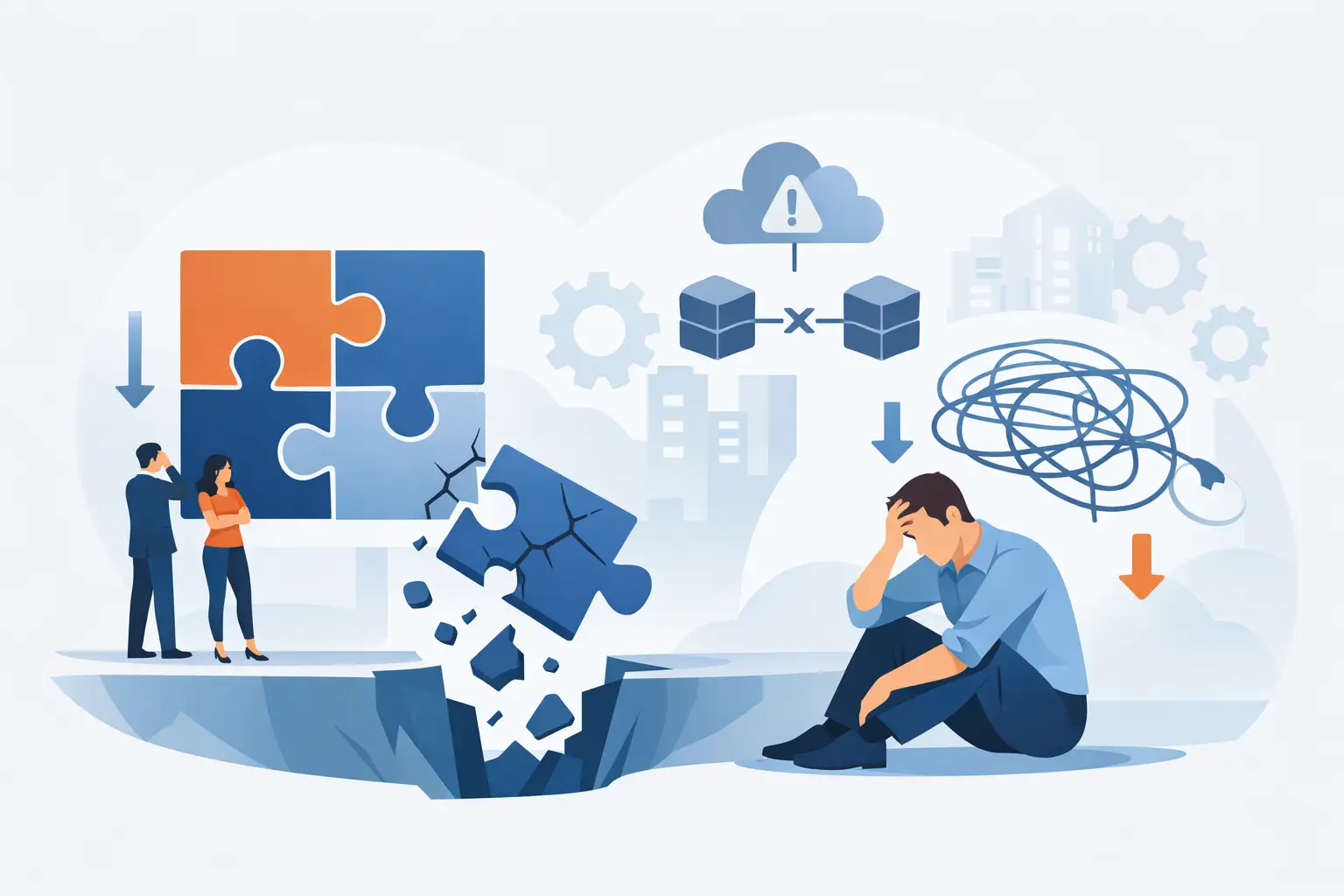
An order from a webshop can be transferred to the ERP, then to the warehouse system and the courier service in seconds. This process seems simple on paper. In practice, however, this is where it becomes clear why integration modernizations fail: it's not the technical implementation of data transfer that causes most problems, but unclear business rules, uncertain data responsibility, and architecture planned without operation.
Many organizations treat modernization as a replacement of an old connection. In reality, integration is part of the operating model. It determines which system has the final say on inventory, price, order status, or billing data, and also who intervenes based on what information in case of an error. If these questions remain open during development, the project can easily turn into a costly error correction cycle.
Why do integration modernizations fail right from the start?
The most common mistake is that the project's starting point is a technological decision: a new API, iPaaS platform, message queue, or intermediary database. These can be justified tools, but they do not replace process mapping. Just because two systems can technically exchange data does not mean they understand the same thing by fulfilled order, available inventory, or credited invoice.
In a wholesale or manufacturing environment, it is particularly common for the same item number to be associated with different life cycles, units of measure, or inventory logic in different systems. The ERP may be the source for financial and master data management, the warehouse management system may track physical movement, and the webshop may apply its own sales rules. If the project only matches fields but does not reconcile these business meanings, errors later appear as master data discrepancies, over-sales, or manual corrections.
Therefore, the goal of modernization should not be defined by which interface replaces the old one. A better question is which operational decisions require reliable data, with what delay, what exception handling, and who is responsible for the result.
The existing process is not the same as the documentation
Many organizations have process diagrams, but they often do not include real exceptions. They do not show what happens during partial delivery, substitute products, manual order modifications, returns, or when an external partner's system is temporarily unavailable.
Experienced operators handle these situations with spreadsheets, emails, and system knowledge. However, a new integration cannot operate based on tacit rules. Exceptions must be modeled in advance: what event initiates a process, which system is the source, what counts as a valid state, and when human approval is necessary.
A faulty data model quietly undermines operations
In integration projects, data-related problems are rarely visible on the first day. Synchronization may run, the dashboard may show a green status, yet incorrect business results may occur. The reason is that the transferred data is structurally correct but inaccurate or incomplete in meaning.
A typical example is inventory. One system communicates the physically available quantity, another deducts reservations, and a third includes supplier availability. If the value is not published to the webshop with a clear definition, sales and the warehouse operate from different realities. The same applies to partner data, price lists, tax rates, order statuses, and shipping addresses.
Each critical data object needs a designated data steward. This does not necessarily mean a single person, but clear responsibility: which application is the authoritative source, who approves change rules, and under what conditions can one system override a value from another.
Without data stewardship decisions, integrations eventually become processes that continuously correct each other. A manual modification is overwritten, a faulty record reappears, or a previously deleted partner becomes active again. These are not simple development errors but unclear data governance issues.
Point-to-point connections quickly become unmanageable
Connecting a single webshop and ERP can often be solved with direct integration. The situation changes when a warehouse management, invoicing, CRM, production planning, supplier feed, carrier platform, or customer portal is added. In such cases, the quickly established network of point-to-point connections creates complex dependencies that are difficult to manage.
A new field, status, or business rule change can affect multiple interfaces. Without a central contract for data formats, versioning, and error handling, the risk of changes gradually increases. Teams often delay necessary developments because they cannot confidently assess the side effects.
Introducing a large integration platform is not always justified. For smaller, well-defined system connections, excessive abstraction can be an unnecessary operational burden. However, for multiple business-critical systems, it is advisable to consciously separate the internal logic of applications from the integration layer. This can be an API-centric architecture, event-driven data transfer, or a controlled intermediary layer. The right choice depends on transaction volume, latency requirements, system maturity, and frequency of changes.
Operation is not a post-development task
Many modernizations become uncertain because the definition of success is limited to going live. A business integration truly proves itself when it behaves in a controlled manner even in the face of partial errors, external service outages, network issues, or unexpected data volumes.
The question is what happens if a message arrives twice, or if a remote API response is uncertain due to a timeout. Can the operation be safely retried? Is it clear which orders need to be checked? Is there an alert that indicates not just a technical error code but also business impact?
Proper observability requires structured logging, correlation IDs, metrics, and interpretable alert rules. The log is useful if it can answer a customer service or operational question: where the order got stuck, what data was received, which rule decided, and whether reprocessing occurred.
The infrastructure side cannot be separated from this. Authentication of connections, secret management, permissions, backups, capacity planning, and update schedules all affect the reliability of integration. A well-written interface does not operate responsibly in an environment without controlled change management or rollback procedures.
Testing should cover business scenarios
Sample data successfully transferred in a test environment does not mean the system is ready for real operation. Testing should cover exceptions, repeated submissions, faulty or missing master data, the order of state changes, and behavior under load.
Defining acceptance criteria in business terms is particularly important. The right question is not whether the API responded, but whether a given business event resulted in a correct, verifiable state in all affected systems. Joint validation by finance, logistics, customer service, and IT is not an administrative step but a tool for reducing operational risk.
Gradual implementation is often a better decision than a one-time full transition. A narrower order type, location, or partner group can provide controlled experience first. This is not always feasible, for example, with highly interconnected core processes, but where possible, it reduces the business impact of errors and clarifies the next steps.
What foundations should modernization be built on?
At the start of a viable integration program, at least four tangible outcomes should be achieved:
- an approved process map that includes normal and exceptional business cases;
- data stewardship and data quality rules for critical objects;
- documented interface contracts with versioning, error handling, and security principles;
- an operational plan with monitoring, alerting, responsibilities, and change management.
These do not slow down development. On the contrary, they reduce late redesigns that appear during the most expensive period under intense business pressure. In the CGAT approach, integration is not a separate development task but a shared design area of processes, application architecture and infrastructure. A successful modernization does not merely move more data between systems. The organization knows more precisely where data originates, what happens in case of an error, and how to introduce the next business change predictably. This is the control that can truly be built upon during growth.
None
Planning a similar system or integration?
Show us the current process and systems. We will help identify the lowest-risk next step.
Key Takeaways
- Integration modernizations often fail due to unclear business rules and data responsibilities.
- Technological decisions without process mapping lead to misunderstandings between systems.
- Data stewardship is crucial to prevent ongoing errors and discrepancies.
- Point-to-point connections can become unmanageable without central contracts for data formats.
- Successful integration requires comprehensive testing and operational planning.
Frequently Asked Questions
Why do integration modernizations often fail?
Integration modernizations often fail due to unclear business rules, uncertain data responsibility, and architecture planned without considering operations.
What is a common mistake in integration projects?
A common mistake is starting the project with a technological decision, such as a new API, instead of mapping the process.
Why is data stewardship important in integration?
Data stewardship is crucial to prevent ongoing errors and discrepancies, ensuring clear responsibility for critical data objects.
Related Engineering Insights
Unifying Dispersed Business Data in Practice
Unifying dispersed business data doesn't start with a new system. First, uncover the data's path, the errors, and the manual steps that slow decision-making.
Reducing Manual Data Entry in Companies
Reducing manual data entry in companies is not just about automation: it leads to clearer processes, fewer errors, and more reliable decisions.
Step-by-Step Mapping of Business Processes
Step-by-step mapping of business processes reveals where time, data, and responsibility are lost, ensuring more stable operations in practice.