System Integration for Manufacturing Companies
Most manufacturing companies struggle with data not because they lack systems, but because they have too many, each operating with different logic. Therefore, system integration for manufacturing companies is not just an IT convenience issue but a cr
Short Answer
Most manufacturing companies struggle with data not because they lack systems, but because they have too many, each operating with different logic. Therefore, system integration for manufacturing companies is not just an IT convenience issue but a critical operational task.
Most manufacturing companies struggle with data not because they lack systems, but because they have too many, each operating under different logic. System integration for manufacturing companies is not just an IT convenience but a crucial operational safety task. If the ERP shows different data than the production system, the warehouse signals late, and scheduling relies on manual interventions, the problem is not local. The architecture is incomplete.
What system integration means for manufacturing companies
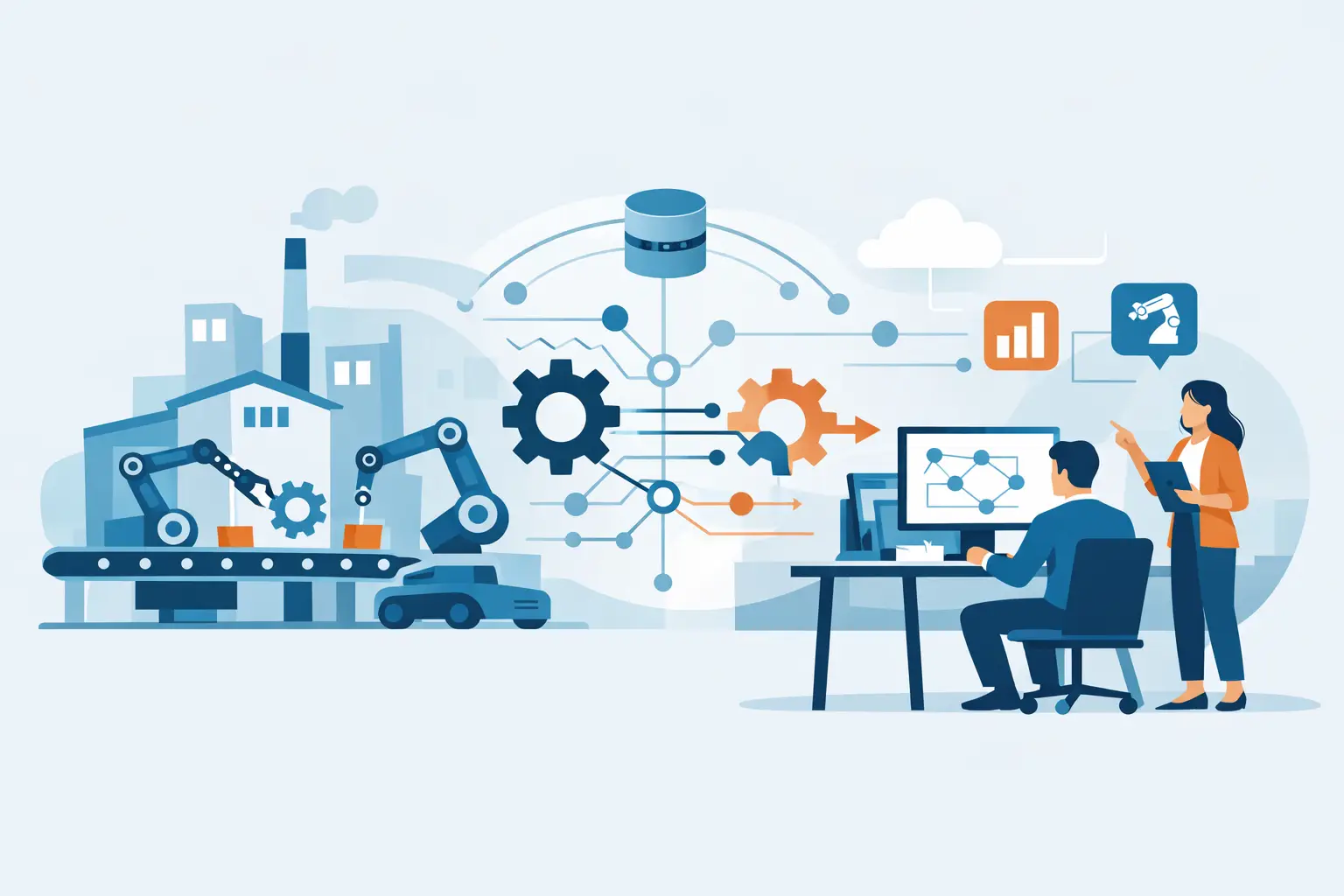
In a manufacturing environment, integration is not merely a data connection between two applications. It involves much more: the unified operation of business, logistics, and production processes. This includes ERP, MES, WMS, maintenance systems, quality assurance modules, shipping platforms, e-commerce interfaces, and often the industrial automation layer as well.
The real question is how these systems share status, transactions, and decision points. In a manufacturing company, every integration error quickly becomes a physical consequence: incorrect stock levels, mis-scheduled production, traceability gaps, downtime, or faulty service. Therefore, an integration project should not be treated merely as a development task. It is much more an infrastructure and management issue.
The most common breaking points in manufacturing
Problems rarely appear where the first symptom is visible. A delayed production order might be due to faulty master data, delayed synchronized inventory, an unvalidated interface, or middleware logic kept alive with patches over the years.
It is common for the ERP to be organized from a financial and inventory planning perspective, but unable to quickly reflect the actual production status. In such cases, production management builds an additional Excel layer around itself. In the short term, this seems workable but actually creates parallel sources of truth. When an audit, complaint, or capacity crisis arises, it's no longer clear which data is accurate.
Another typical breaking point is the time difference between warehouse and production systems. If the WMS and production execution do not operate with the same event logic, the inventory may theoretically be available but practically immovable. This is not just a productivity issue but a supply risk as well.
The third recurring problem is the boundary between the automation level and enterprise applications. In many companies, PLC, SCADA, or sensor data is available, but there is no well-defined path to higher-level systems. The result is an abundance of data without decision support.
Why simple interface development is not enough
A single point connection can yield quick results, but in a scaled manufacturing environment, it soon becomes expensive and difficult to maintain. Every new connection creates additional dependencies, and within a few years, the situation arises where no one fully understands the system connection map.
This is where the role of architectural discipline comes in. The main question is not whether two systems can be technically connected, but whether the integration meets availability, logability, authorization, validation, and recovery expectations. For a manufacturing company, an interface is good if it operates predictably under operational conditions, its error handling is controlled, and it does not create new operational uncertainties.
Therefore, system integration for manufacturing companies is always a governance issue as well. Data stewardship is needed, system ownership responsibility is required, change management is necessary, and monitoring is needed that not only shows whether the connection is running but also whether it conveys the correct business status.
What architecture works in an industrial environment
There is no single universal pattern. The architecture depends on whether the company is engaged in discrete manufacturing, operates in continuous production, how standardized the machinery is, the ERP maturity, and how many legacy systems remain in the organization. Yet, there are constant principles.
The first is that the integration layer should not preserve business chaos. If master data is disorganized, item number logic is inconsistent, or the definitions of state changes vary by department, technology will only spread the error faster. Data and process cleansing is needed before or parallel to integration.
The second principle is deterministic operation. In a critical environment, it is unacceptable for a connection to sometimes work, sometimes delay, sometimes duplicate. Clear event handling, idempotent processing, loggable transactions, and replayability are needed. These are not over-engineered elements but the foundations of operational safety.
The third is layering. Production control, operational execution, business administration, and decision support operate with different time sensitivities. If these are mixed in a single loosely assembled data stream, the entire system becomes vulnerable. A well-designed architecture, therefore, clearly manages what happens in real-time, what happens near real-time, and what happens as periodic synchronization.
Where integration truly pays off
The return is rarely measurable only in terms of labor savings. In a manufacturing environment, the significant gain usually appears in the quality of decision points and the reduction of operational risk.
If demand from sales and production capacity rely on the same current status, commitment accuracy improves. If warehouse movements, production feedback, and quality statuses are uniformly trackable, troubleshooting time decreases and traceability increases. If operations receive real alerts and performance data, there will be fewer unexpected outages.
However, there is a less visible but strategically important benefit: manageability. In an integrated, documented, supervised system environment, change is not a blind risk. This is especially important when a new site, new production line, new logistics model, or new regulatory obligation emerges.
When to consider modifying the existing environment
Not always when the problem is completely obvious. The most expensive projects are usually those that have been postponed too long. If operations are already person-dependent, if interface documentation is lacking, if production and business sides regularly dispute each other's data, or if a version update alone poses a business risk, then reviewing the integration architecture is timely.
A complete replacement is not always necessary. Often the right step is to establish a controlled intermediary layer, reorganize critical data streams, and strengthen governance. Other times, legacy connections are so disorganized that gradual improvement only prolongs exposure. There is no general recipe here. The decision is determined by system criticality, downtime cost, compliance expectations, and internal operational maturity.
How to lead such a project
Technology selection is not the first step. First, the operational reality must be modeled: which system is the authoritative source for a given data set, where decisions are made, where approvals occur, what is the acceptable delay, and what happens in case of error. Without this, the integration plan will be logical at most at the developer level, not at the operational level.
Then comes validation. It's not just about testing whether the message goes through, but also how the entire chain behaves under load, partial failure, network disturbance, and operational peak times. In manufacturing environments, the biggest errors do not appear in lab conditions but during live shift changes, campaign launches, or stock shortage situations.
A responsible approach, therefore, requires engineering management, not development capacity. Leadership that understands corporate applications, infrastructure, security controls, and the time-critical characteristics of industrial operations simultaneously. In this space, system integration is not an ancillary service but one of the prerequisites for operational continuity. In the CGAT approach, integration is therefore always interpreted with architectural discipline, validated implementation, and a sustainably operable management system in the long term.
In manufacturing, the competitive advantage is not in how many systems operate within the organization, but in how predictably they work together when the load increases, the margin for error narrows, and the consequences are not just digital but business-related.
Planning a similar system or integration?
Show us the current process and systems. We will help identify the lowest-risk next step.
Key Takeaways
- System integration in manufacturing is crucial for operational security, not just IT convenience.
- Integration involves unifying business, logistics, and production processes, including ERP, MES, WMS, and automation.
- Common issues include time differences between systems and lack of clear data paths from automation to higher-level systems.
- Architectural discipline is essential to avoid creating new dependencies and operational uncertainties.
- Integration improves decision quality and reduces operational risk, enhancing manageability and traceability.
Frequently Asked Questions
Why is system integration important for manufacturing companies?
System integration is crucial for manufacturing companies because it ensures operational security and unifies business, logistics, and production processes, reducing errors and improving efficiency.
What are common issues faced in manufacturing system integration?
Common issues include time differences between systems, lack of clear data paths from automation to higher-level systems, and the creation of parallel sources of truth due to inconsistent data handling.
How can manufacturing companies benefit from system integration?
Manufacturing companies benefit from improved decision quality, reduced operational risk, and enhanced manageability and traceability, leading to better commitment accuracy and fewer surprise outages.
Related Engineering Insights
Unifying Dispersed Business Data in Practice
Unifying dispersed business data doesn't start with a new system. First, uncover the data's path, the errors, and the manual steps that slow decision-making.
Reducing Manual Data Entry in Companies
Reducing manual data entry in companies is not just about automation: it leads to clearer processes, fewer errors, and more reliable decisions.
Step-by-Step Mapping of Business Processes
Step-by-step mapping of business processes reveals where time, data, and responsibility are lost, ensuring more stable operations in practice.