Supply Chain Digitalization Trends in 2026
Supply chain digitalization trends are no longer just presentation topics but operational necessities. For most companies, the question is not whether new digital capabilities are needed, but how to create controlled data flow among existing ERP, WMS, TMS, manufacturing, and partner systems without increasing risk.
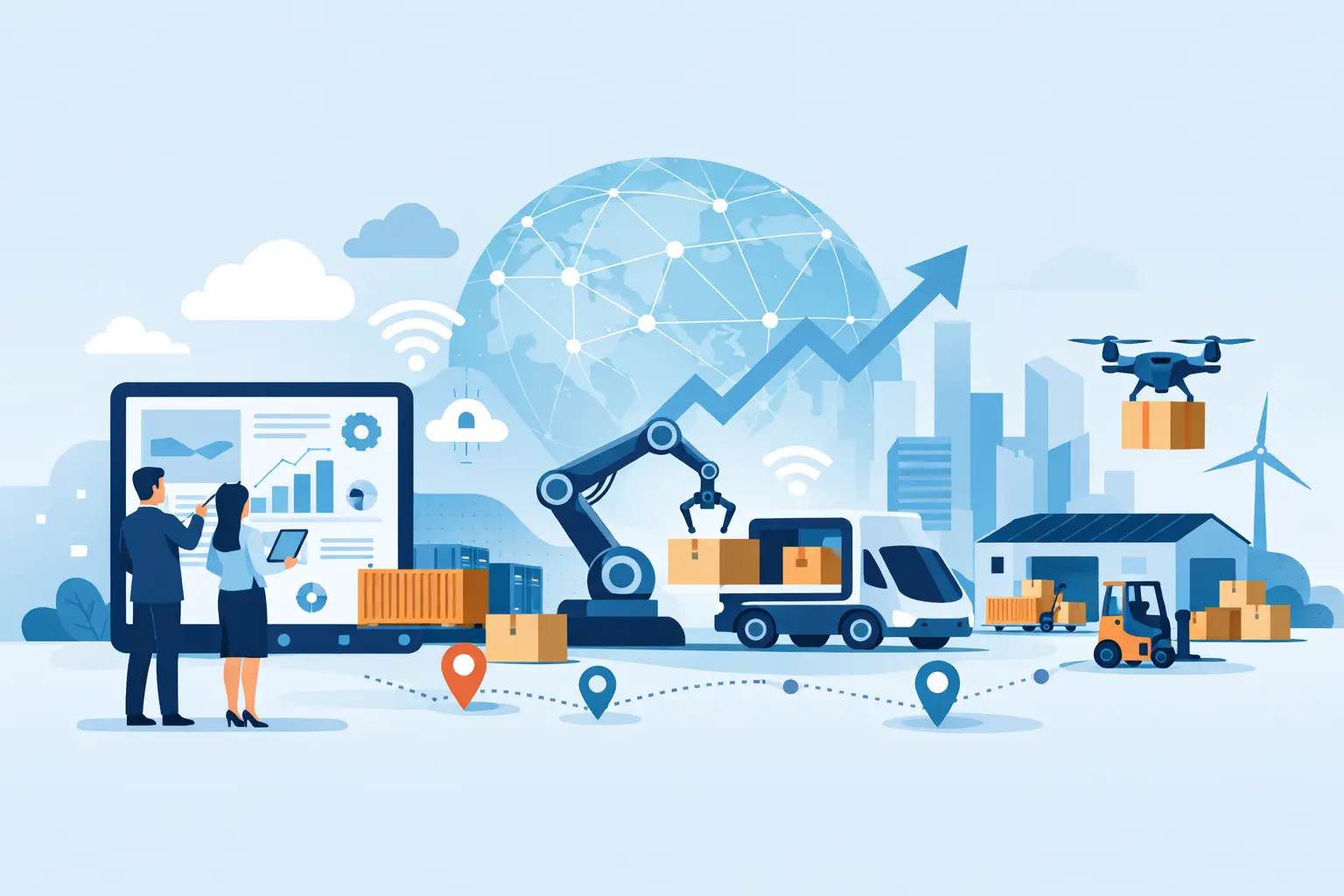
Short Answer
Supply chain digitalization trends are now operational necessities rather than presentation topics. The key question for most companies is not whether new digital capabilities are needed, but how to create controlled data flow among existing systems.
Supply chain digitalization trends are no longer just presentation topics but operational necessities. For most companies, the question is not whether new digital capabilities are needed, but how to create controlled data flow among existing ERP, WMS, TMS, manufacturing, and partner systems without increasing risk. Organizations that treat this merely as a software implementation task often quickly reach the point of integration congestion, data quality uncertainty, and operational vulnerability.
What has changed behind the supply chain digitalization trends?
A few years ago, it seemed sufficient for a company to optimize a single function. Separate projects dealt with warehousing, procurement, and logistics. This approach worked until market fluctuations, supply disruptions, energy prices, labor shortages, and compliance pressures revealed that local optimization often causes global instability.
Current trends are increasingly less about flashy digitalization and more about end-to-end operational discipline. Business leaders want a more real-time view of inventory, order status, supplier performance, and production constraints. At the same time, they expect this visibility to be auditable, controllable, and reliable.
1. Data reliability takes precedence over data visibility
Many organizations already have dashboards, reports, and data exports. The problem is that these often rely on different definitions. Inventory is calculated differently in the ERP, the WMS shows something else, and sales sees yet another picture on the order management interface. In such an environment, digitalization does not speed up decision-making but formalizes uncertainty.
One of the strongest trends is therefore the standardization of operational data. It is not just about data collection but about designating which system is responsible for which data, how synchronization occurs, what data latency is acceptable, and how discrepancies are managed. This is less spectacular than a new AI project but has a much greater business impact.
In companies where master data discipline is weak, subsequent automation remains fragile. Poor data not only leads to poor forecasting but also causes incorrect procurement, misallocation of inventory, and inaccurate customer commitments.
2. Architectural connections replace point-to-point integrations
Most supply chains today do not run on a single platform. ERP, WMS, TMS, MES, e-commerce engines, supplier portals, EDI connections, carrier APIs, and industrial data sources operate in parallel. In the past, these were often connected in an ad hoc manner. A quick interface here, a custom export there, and over time, a complex integration network developed.
The current trend, however, is that companies are beginning to think in terms of integration architecture. This means not every system communicates directly with every other system, but a regulated, monitorable, versionable connection model is established. This is particularly significant in environments where downtime causes business loss, compliance issues, or customer service errors.
Here, the trade-off also appears. Quick interfaces may seem cheaper in the short term but increase troubleshooting time, modification costs, and dependency risks in the long run. Regulated integration starts more slowly but remains more manageable when a new site, logistics partner, or sales channel is added to the system.
3. AI and predictive models are sharpening, but only under tight control
AI is strongly present among supply chain digitalization trends, but real corporate value is not created where general promises are made. For most organizations, the main question is not whether AI can be used, but in which processes the model's uncertainty is acceptable.
Predictive models indeed have a place in demand planning, inventory level optimization, supplier risk assessment, and capacity forecasting. However, these only yield business results if input data is stable, decision logic is traceable, and human oversight exists. A black-box model that is not explainable and not embedded in corporate governance creates more problems than it solves, especially in regulated or high-availability environments.
More mature companies therefore do not grant full autonomy to AI. Instead, they use it for decision support in well-defined processes, with measured business impact and clear accountability.
4. Demand for real-time operations is growing, but not everywhere requires true real-time
Real-time data often appears as a basic requirement in management materials, but technically and business-wise, this is not justified for every process. In automated warehouse processes, production material supply, or shipment status tracking, updates measured in seconds can be critical. In strategic inventory planning or supplier performance evaluation, minute or hourly delays may suffice.
The trend is therefore not simply real-time but system design according to appropriate time-criticality. This requires architectural discipline. Designing every process to be real-time can unnecessarily increase infrastructure costs, error handling complexity, and the number of dependency chains. Conversely, if the system is too slow where operational decisions depend on seconds, digitalization loses its value.
The right approach here is differentiated. It should be determined based on business impact, not technological fashion, where event-driven operation is necessary and where scheduled data updates suffice.
5. Digital twins and simulation become tools for decision preparation
Digital twins have long appeared primarily in manufacturing contexts but are increasingly extending to the entire supply chain. It is not necessarily a complete, detailed replica but a modeled environment where the company can test different operational scenarios.
This is particularly valuable in network design, inventory placement, peak season management, or assessing the impact of supplier outages. Simulation is useful when it is not a static presentation but truly builds on operational data and real process parameters.
There is also a limit here. Overly ambitious modeling can quickly lead the project in a costly, hard-to-maintain direction. Often, a narrower but reliable decision-support model is better than a grandiose but operationally unusable digital twin.
6. Cybersecurity and access management have become part of the supply chain
Digitalization used to appear mainly as an efficiency issue. Today, due to the increase in the number of system connections, the involvement of external partners, API-based data exchange, and the convergence of OT and IT, it is also a security issue. One of the least spectacular but most important elements of supply chain digitalization trends is the control of permissions, service connections, and data movements.
A poorly managed integration can not only cause data discrepancies but also open up attack surfaces. Therefore, leading organizations no longer treat access as an administrative side issue but regulate it at the architectural level. This includes the principle of least privilege, control of service accounts, event logging, change management, and review of partner connections.
This is particularly important in operations where logistics, warehousing, or manufacturing disruptions cause direct revenue loss. High availability and security here are not separate projects but part of the same operational discipline.
7. Controlled modernization often wins over platform replacement
Many companies feel their current systems are too fragmented, so they consider a complete platform change. In some cases, this may be justified, but in practice, a complete rebuild carries significant transition risk. Especially if processes differ by site, master data is disorganized, or the business does not tolerate a longer stabilization period.
Therefore, the trend favoring controlled modernization is strengthening. Its essence is that the company does not replace everything at once but intervenes in architectural order. First, it stabilizes critical integration points, then improves visibility, and gradually automates processes where business benefit and technical maturity meet.
Such a program is less spectacular than a full transformation announcement but fits much better with corporate environments where operational continuity is non-negotiable. This approach is also close to CGAT's perspective: digitalization is only considered progress if system integrity, governability, and operational stability also improve.
What should be prioritized now?
In the coming period, the advantage will not go to the company that names the most new technologies in its strategy. The advantage will go to the one that can decide where in the supply chain greater visibility is needed, where stronger data discipline is required, where decision automation is justified, and where control over system connections should be reinstated.
Thus, digitalization trends do not point in a single direction. The common denominator is operational predictability. If an organization keeps this in mind, technological investment will not generate more complexity but measurably improve supply security, decision quality, and business resilience. This is the point where digitalization finally becomes a disciplined operational capability rather than a promise.
Planning a similar system or integration?
Show us the current process and systems. We will help identify the lowest-risk next step.
Key Takeaways
- Supply chain digitalization is now an operational necessity, not just a presentation topic.
- Standardizing operational data is crucial for reducing uncertainty and improving decision-making.
- Architectural integration models replace ad hoc connections, enhancing system manageability.
- AI is used for decision support in well-defined processes, not for full autonomy.
- Controlled modernization is preferred over complete platform replacement to ensure operational continuity.
Frequently Asked Questions
Why is data standardization important in supply chain digitalization?
Data standardization is crucial because it reduces uncertainty and improves decision-making by ensuring consistent and reliable data across different systems.
How does AI contribute to supply chain digitalization?
AI is used for decision support in well-defined processes, providing value in areas like demand planning and risk assessment, but requires stable input data and human oversight.
What is the trend in system integration for supply chains?
The trend is moving towards architectural integration models that replace ad hoc connections, making systems more manageable and reducing long-term risks.
Related Engineering Insights
Process Automation or Process Improvement?
Process Automation or Process Improvement? We show when it's necessary to simplify work first and when automation adds value to operations.
Dashboard Design Guide for Business Leaders
Dashboard design guide for leaders: transform scattered data into a reliable, decision-supporting operational view every day, without unnecessary spreadsheets.
Review of Manufacturing Management System
Reviewing the manufacturing management system uncovers hidden losses, improves data quality, and makes production more predictable day by day.