PLC Data Connection with ERP System: What Works?
For most manufacturing companies, the question is not whether a data connection between PLC and ERP is needed, but how it can be implemented reliably, auditable, and sustainably in the long term. If the production line statuses, cycle times, quantities, or scrap data appear directly in the ERP, business decisions are accelerated, while the margin of error between plant management and corporate IT is significantly reduced.
Short Answer
A stable PLC–ERP data connection requires a regulated intermediate integration layer, a unified data model, and auditable error handling. Direct, uncontrolled connections can lead to data discrepancies and production risks.
For most manufacturing companies, the question is not whether a PLC data connection with an ERP system is needed, but how to implement it reliably, auditable, and sustainable in the long term. When production line statuses, cycle times, quantities, or scrap data appear directly in the enterprise resource planning system, business decisions accelerate. At the same time, the margin of error between the operational management world and corporate IT is drastically reduced.
Therefore, linking PLC and ERP is not a simple interface task. It is actually an architectural issue. The manufacturing environment expects deterministic operation, while the ERP demands business consistency, traceability, and transactional discipline. If one tries to force these two logics together directly without an appropriate intermediary layer, it will eventually lead to data loss, state discrepancies, or production risks.
What does PLC data connection with ERP system really mean?
The term often appears misleadingly as if the PLC directly connects to the ERP, and the task ends there. In reality, the PLC is typically a machine or cell-level controller that works with real-time signals, state changes, and technological events. In contrast, the ERP handles orders, inventory movements, operational feedback, cost data, and corporate master data.
The connection between the two systems is therefore not merely a matter of communication protocol. It involves data reporting, state interpretation, and responsibility boundaries. It must be decided which system is the source of truth for a given data, how frequently the transfer occurs, what event triggers it, and what happens if either side is temporarily unavailable.
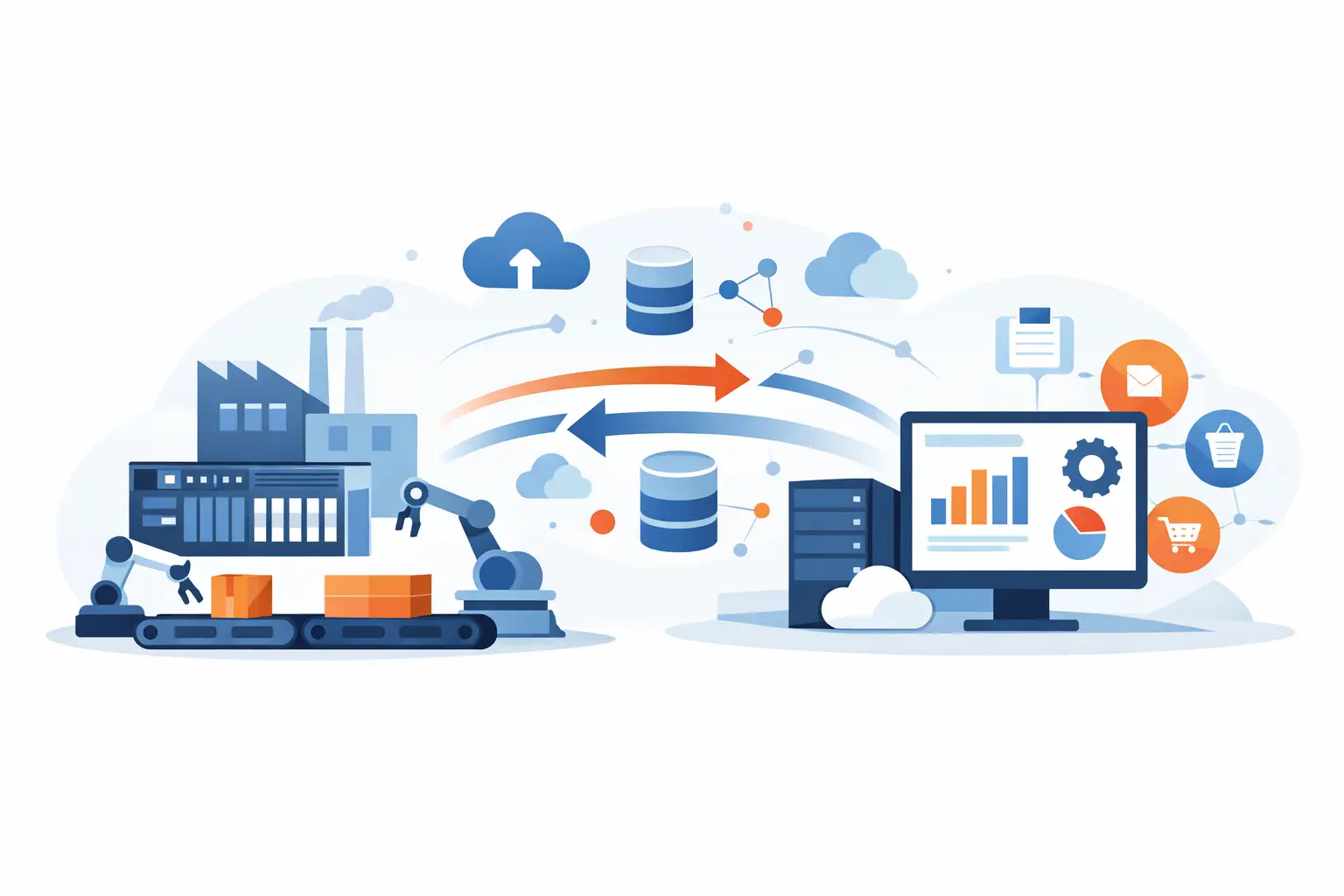
In a well-designed solution, the PLC does not speak ERP language. An intermediary integration or production-near layer performs the normalization, validation, buffering, and business contextualization of the data. This can be an MES, a data collection layer above SCADA, industrial middleware, or a dedicated integration service. The form is environment-dependent, the function is not.
Why do many PLC-ERP integrations fail?
The most common mistake is an overly direct approach. If the project's goal is solely for the ERP to "see" some machine data, planning can easily get stuck at the tag list, driver, and data connection level. This initially yields quick results, but under operational load, deficiencies quickly become apparent.
The first problem is the semantics of data reporting. In a PLC, the counter value increases, while in an ERP, there are recorded events. The two are not the same. For example, if a cycle counter is interpreted by the ERP as production feedback, but restart, manual correction, or maintenance status is not handled, the business data will be incorrect, even though the communication technically works.
The second problem is time management. The PLC environment works with millisecond or sub-second events, while the ERP typically uses minute or transaction-based processing. Without intermediary event handling and time series logic, a momentary machine state can lead to erroneous business conclusions.
The third problem is the lack of operational discipline. Many integrations work until the original development team is present. As soon as a firmware update, network transformation, ERP version change, or production line modification occurs, it becomes apparent that there is no version-controlled interface description, no data owner, no rollback plan, and no monitoring tailored to the live environment.
The correct architecture is not shorter, but safer
A PLC data connection with an ERP system becomes usable at the enterprise level when it is built in a layered architecture . This is not an administrative excess but an operational safety principle.
At the machine level, PLCs and industrial devices provide production, status, and diagnostic data. Above this, a collection or intermediary layer is advisable, which handles protocol-level connection, timestamping, buffering, and event creation. The ERP integration works from this consistent, validated data set. Thus, the enterprise resource planning system does not receive raw signals but business-interpretable events, such as production operation completion reports, scrap accounting, or material usage feedback.
This model is advantageous from several perspectives. It separates the real-time automation layer from the enterprise transaction layer, reduces direct dependencies, and allows for error isolation. If the ERP is temporarily unavailable, production does not stop. If a PLC is replaced, there is no need to redesign the business side, only to adjust the collector layer connection.
What data should be transferred?
Not all data available in the PLC is valuable for the ERP. Typically, three data types are directly related to managerial decisions and business processes.
The first is production event data. This includes the start and end of operations, the quantity produced, scrap, categorized reasons for machine downtime, or status tied to item identifiers. These directly impact inventory, accounting, and production planning.
The second is quality and traceability data. If regulated industries or customer compliance requires it, certain manufacturing parameters, recipe versions, measured values, and operator approvals can also be transferred. Here it is especially important to decide what goes into the ERP and what remains in dedicated quality or production-near systems.
The third is availability and performance data, but only after proper aggregation. The ERP rarely needs second-by-second state changes. It is much more useful to have validated metrics projected onto shifts, orders, or production lots.
Too much data results in noise, not transparency. The goal of integration is not to transfer every available value but to ensure verifiable alignment between business and production reality.
Protocol, interface, security
Technically, communication can be solved in several ways, but protocol choice alone is not a strategy. OPC UA, MQTT, REST-based intermediary services, database-based transfer, or manufacturer connectors can all work if the architecture and operation are in order. If not, none will solve the structural issues.
Security requires special attention. Directly connecting PLCs to corporate systems or open network zones is particularly risky. Proper network segmentation, authorization management, authentication, logging, and traffic regulation are not optional, especially if the production environment is continuously operating or subject to audits.
Equally important is the interface contract. Data fields, data types, sending conditions, error codes, resend logic, and version control must be documented. An undocumented integration is not a faster solution but a future incident source.
During implementation, development is not the hardest part
The critical point of the project is usually not establishing the initial connection but clarifying organizational and operational conditions. Who is responsible for data accuracy? What counts as an official production event? Who can approve interface changes? What test environment is available? What is the procedure during ERP maintenance windows or production shutdowns?
Without these, the PLC-ERP connection can easily become a subject of political and operational disputes. The automation team defends the machine logic, the ERP side the business consistency, and operations expect immediate results. Without senior architectural leadership, these three perspectives rarely align on their own.
A disciplined implementation usually starts with assessment and data model design, followed by validated interface specification, and then phased pilots. It is not advisable to think in terms of a single large transition but in well-defined production processes. This way, errors can be localized, metrics compared, and the benefits become visible on the business side.
When is it worth it, and when is it not?
A PLC data connection with an ERP system pays off quickly when production feedback is currently manual, data discrepancies between production and inventory are frequent, or management receives reliable performance information late. In such cases, integration is not a convenience development but a control tool.
However, deep ERP integration is not always justified. If the manufacturing process is very variable, the machine park is heterogeneous, and there is no unified production-near data structure, it may be necessary to first organize shopfloor data collection. The same applies if master data on the ERP side is disorganized or production processes are not consistently modeled. Building automation on faulty foundations only reproduces errors faster.
A well-built integration is therefore not merely a technological investment. It is a management decision about how much the company wants to organize its industrial and business data flows into a single, verifiable operational order. For organizations where availability, compliance, and decision accuracy are non-negotiable, this connection is not an extra capability but part of operational discipline.
If the goal is not just data transfer but reliable corporate operation, the connection between PLC and ERP should be treated not as an interface but as critical infrastructure.
Planning a similar system or integration?
Show us the current process and systems. We will help identify the lowest-risk next step.
Key Takeaways
- A regulated intermediate integration layer is essential for a stable PLC–ERP connection.
- A unified data model helps in maintaining consistency and reliability.
- Auditable error handling is crucial to mitigate risks.
- Direct connections without control can cause data discrepancies.
- Proper architecture and operation regulation ensure long-term sustainability.
Frequently Asked Questions
Why is a regulated integration layer important for PLC–ERP connections?
A regulated integration layer ensures stability and consistency in data transfer, reducing the risk of discrepancies and production issues.
What are the risks of direct PLC–ERP connections?
Direct connections without control can lead to data discrepancies and increase production risks.
How does a unified data model benefit PLC–ERP integration?
A unified data model ensures consistency and reliability in data exchange, facilitating better business decision-making.
Related Engineering Insights
Automating Reporting for Executive Decisions
Automating reporting for executive decisions: less manual data collection, clearer indicators, faster and more verifiable executive decisions in practice.
Unifying Dispersed Business Data in Practice
Unifying dispersed business data doesn't start with a new system. First, uncover the data's path, the errors, and the manual steps that slow decision-making.
Reducing Manual Data Entry in Companies
Reducing manual data entry in companies is not just about automation: it leads to clearer processes, fewer errors, and more reliable decisions.