Industrial Automation Software Integration
On a production line, the greatest risk rarely arises where the error is loudest. More often, it is the silent breakpoints that cause losses: when the PLC sees the status, but the ERP does not; when the MES knows the scrap rate, but the management re
Short Answer
Industrial automation software integration involves more than just connecting machines and business systems. It requires coordinated collaboration across control, production, logistics, and enterprise management layers to ensure data integrity and operational safety.
On a production line, the greatest risk rarely arises where the error is loudest. More often, silent breaking points cause losses: when the PLC sees the status, but the ERP does not; when the MES knows the scrap rate, but the management report updates two days later; or when the warehouse system and production talk about the same material, but with different identifiers. Therefore, industrial automation software integration is not a simple development task, but an architectural and operational safety issue.
What does industrial automation software integration really mean?
Many organizations interpret the term too narrowly, as if it were solely about data connections between machines and business systems. In reality, it involves more: the coordinated cooperation of control, production, logistics, and enterprise management layers, in such a way that the path, authenticity, timing, and authorization management of data are also planned.
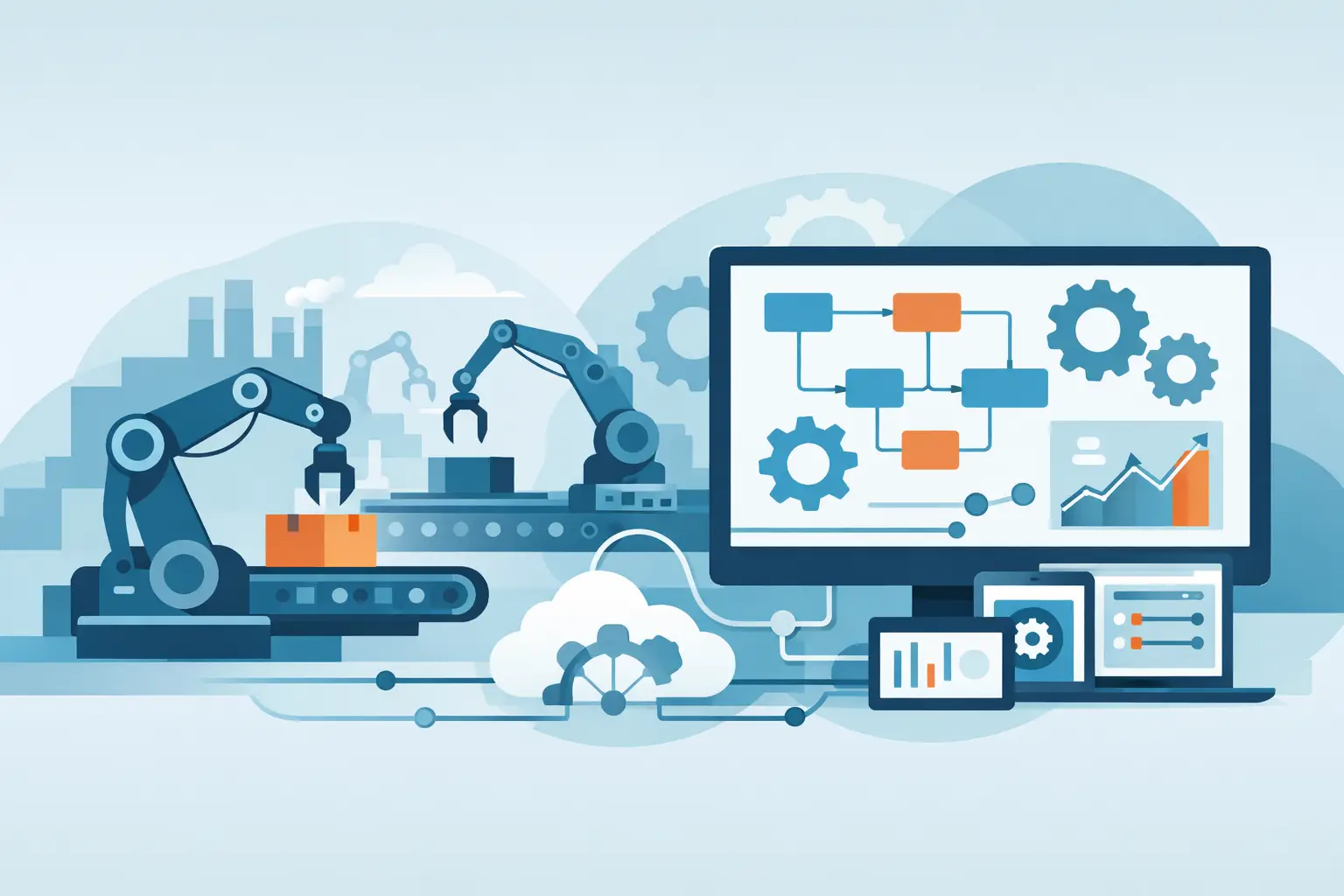
In an industrial environment, integration usually takes place across multiple levels. At the lower levels are sensors, PLCs, SCADA, and HMI systems. Above them appear the MES, quality assurance or maintenance system, then the ERP, WMS, TMS, and sometimes e-commerce or customer service platforms. If only occasional interfaces are built between these, the system will become unmanageably complex over time.
True integration does not mean that everything is connected to everything else. It means the data source is known, the responsibility model is clear, change management is controlled, and in case of error, operational functioning does not collapse.
Why do many integration projects fail?
The first mistake is usually defining integration as an IT task, while it has a direct impact on production processes, inventory accuracy, delivery, and often compliance. If the operational and corporate sides do not work within a common architectural framework, the project quickly slips into partial optimization.
The second problem is underestimating protocols and data models. OPC UA, Modbus, MQTT, REST, or direct database access alone is not a strategy. The interface technology is just one layer. The harder question is what counts as an event, which system is the master of the given data, how timestamps, unit conversions, versioning, and write-backs are handled.
The third reason is ignoring operational realities. Many integrations are built according to laboratory logic, while a manufacturing plant is not a lab. There are partial network outages, manual interventions, operations without maintenance windows, and legacy systems that cannot be easily replaced. Those who do not plan for this are not building integration but a new error surface.
The business impact of industrial automation software integration
The value of integration is not measured by how many interfaces are completed. The real result is seen where decision latency decreases and operational control improves. If production events reach enterprise management and logistics systems with the right context, material planning becomes more accurate, exception handling faster, and performance evaluation more reliable.
This is especially important in environments where production and commercial sides are closely linked. An incorrect inventory status or a delayed production feedback is not just an internal efficiency problem but also a customer-level risk. The same is true for regulated sectors, where auditability, traceability, and access control are not optional but fundamental requirements.
A well-designed integration also helps keep technical debt in check. Not every old system is bad, but undocumented, person-dependent, and directly wired connections are unpredictable in the long run. In a disciplined architecture, the cost of change becomes more foreseeable.
What architecture works in an industrial environment?
There is no single correct pattern, but there are recurring principles. One such principle is the separation of layers. It is not advisable to expose the operational control level directly to every corporate system request. An intermediate integration or event handling layer is often needed, capable of regulating traffic, transforming data, logging, and providing fault tolerance.
Another fundamental principle is respecting deterministic operation. In a production environment, priorities differ from those in a general business application. It is unacceptable for a new reporting function or an ERP-side modification to significantly affect the real-time processes of the plant. Therefore, the design of data collection, buffering, asynchronous communication, and failover mechanisms is critically important.
Cybersecurity is also a key issue. Connecting industrial and corporate systems increases the attack surface. Segmentation, the principle of least privilege, authenticated communication, and change management are not administrative burdens but part of operational safety. Those who handle integration solely from a functionality perspective are preparing for the most expensive mistake.
How should an integration program be approached?
Most organizations lose time and money by choosing tools too early and clarifying the architecture too late. The first step is not development but mapping the system and uncovering critical processes. It is essential to know which connections support core operations, which are only for reporting, and at which points a data error or delay causes real business damage.
Next comes organizing the data and responsibility model. Which system is the source of inventory data? Where is the production status generated? What qualifies as a final event, and what is just a temporary state? These questions often bring organizational conflicts to the surface, but without them, integration remains unstable.
A gradual scheduling is advisable for implementation. Large programs that replace everything at once are spectacular but rarely justified in an industrial environment. A phased model is much more effective, where first the high business value and well-defined connections are placed on stable foundations, and then further expansion builds on this. This does not mean slowness but controlled risk management.
Validation should not be left to the end of the project. Interfaces must be tested not only functionally but also under load, in error states, with network disturbances, and partial availability. An integration is industrial-grade if it behaves predictably even under non-ideal conditions.
The trade-offs leaders should be aware of
In the field of industrial automation software integration, few decisions are black and white. A central platform can improve transparency and manageability but increase dependency on a single component. Point-to-point connections can provide a faster start but almost always increase complexity in the long run. Real-time data flow is tempting, but not every business process requires millisecond updates, and where not justified, it only means unnecessary load and error risk.
It is also a common dilemma how long to keep legacy systems. If a system reliably serves a critical process, a full replacement is not necessarily the best path. In such cases, integration can be both a transitional and strategic tool: it decouples risky dependencies while allowing time for targeted modernization.
A governance-first organization does not merely seek development capacity but architectural leadership capable of weighing the perspectives of operations, IT, compliance, and long-term sustainability simultaneously. At this point, rapid interface development and responsible integration engineering diverge.
What to look for when selecting a partner?
In industrial integration, it is not enough for a partner to know application development. The crucial question is whether they understand availability, change risk, system boundaries, and operational discipline. Can they design in such a way that documentation, operational model, rollback scenarios, and authorization scheme are as much a part of the solution as the code itself?
It is also telling how the partner talks about migration. Serious engineering organizations do not promise frictionless transitions under all circumstances. Instead, they clearly outline dependencies, validation points, and acceptable compromises. This kind of discipline is less flashy but significantly more valuable in an operational environment.
The CGAT approach is relevant in this area because it treats integration not as an isolated software project but as a guided infrastructure and architectural task, where business continuity is a primary design consideration.
Ultimately, connecting industrial systems is not about moving more data across the network. It is about making the company's critical processes more controllable, predictable, and sustainable under load. If integration does not serve this purpose, it only creates more complexity. However, if built with proper architectural discipline, it quietly eliminates those breaking points that cause the greatest business harm.
Planning a similar system or integration?
Show us the current process and systems. We will help identify the lowest-risk next step.
Key Takeaways
- Industrial automation software integration is crucial for reducing decision latency and improving operational control.
- True integration involves coordinated collaboration across multiple layers, not just connecting systems.
- Ignoring operational realities and underestimating protocols can lead to integration project failures.
- A phased approach to integration is more effective than large-scale replacements in industrial environments.
- Selecting the right partner requires understanding availability, change risk, and operational discipline.
Frequently Asked Questions
What is industrial automation software integration?
It involves the coordinated collaboration of control, production, logistics, and enterprise management layers to ensure data integrity and operational safety.
Why do integration projects often fail?
Failures often occur due to defining integration as an IT task, underestimating protocols, and ignoring operational realities.
How should an integration program be approached?
A phased approach is recommended, starting with mapping the system and uncovering critical processes, followed by organizing data and responsibility models.
Related Engineering Insights
Reducing Manual Data Entry in Companies
Reducing manual data entry in companies is not just about automation: it leads to clearer processes, fewer errors, and more reliable decisions.
Step-by-Step Mapping of Business Processes
Step-by-step mapping of business processes reveals where time, data, and responsibility are lost, ensuring more stable operations in practice.
Warehouse Picking Digitalization Example in 6 Steps
A real-world example of warehouse picking digitalization: less searching, fewer errors, better inventory visibility, and more predictable fulfillment every day.