How to Modernize Critical Legacy Systems?
A ten-year-old ERP, a custom-developed warehouse application, or an old order processing system often remains in operation not because it is suitable, but because daily operations rely on it. When the question arises of how to modernize critical lega
Short Answer
A ten-year-old ERP, a custom-developed warehouse application, or an old order processing system often remains in operation not because it is suitable, but because daily operations rely on it. When the question arises of how to modernize critical lega
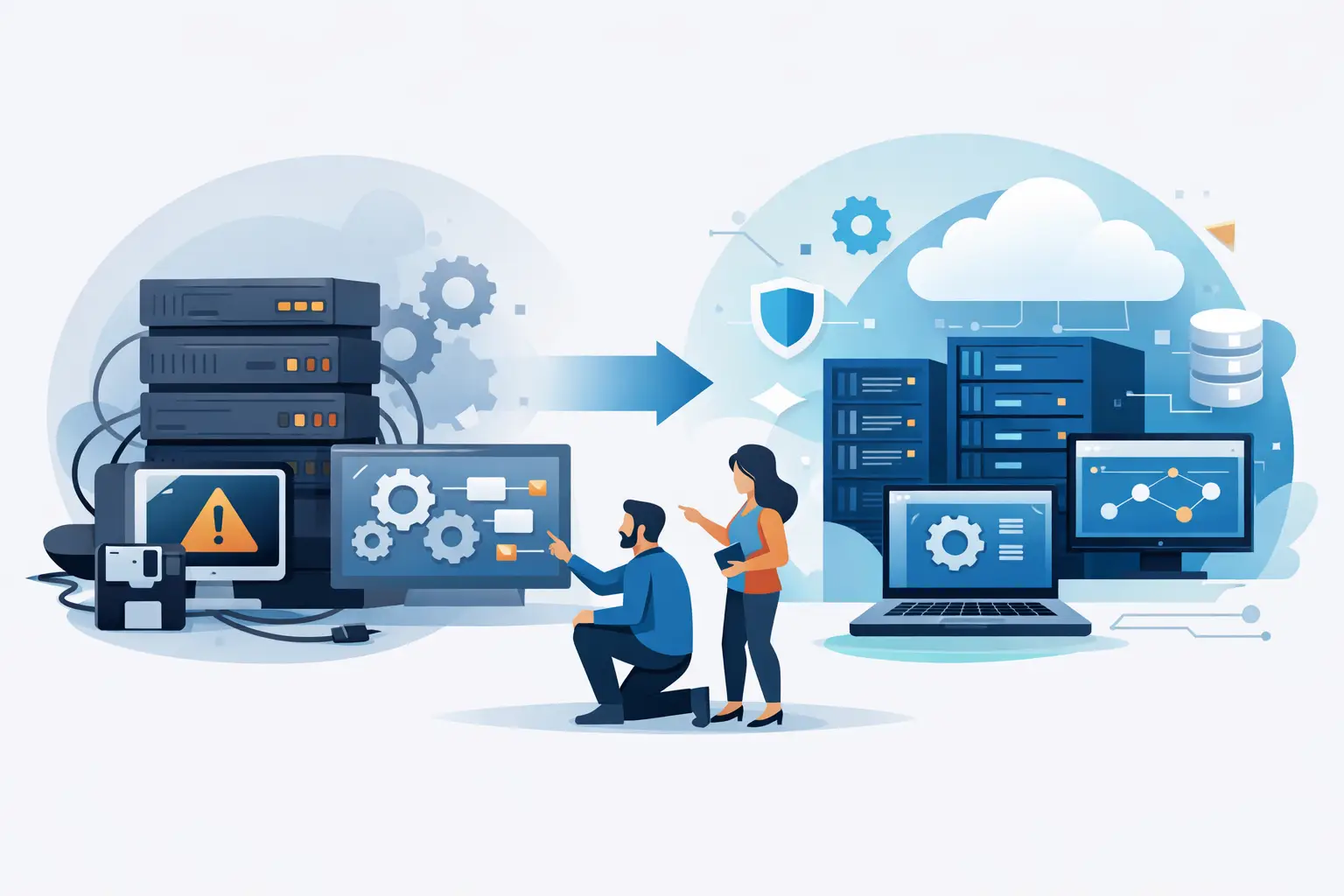
A ten-year-old ERP, a custom-developed warehouse application, or an old order processing system often remains in operation not because it is adequate, but because daily operations have been built around it. When the question arises of how to modernize critical legacy systems, the wrong answer is usually a complete, one-time replacement. The right answer begins with uncovering processes, dependencies, and business risks.
Modernizing a critical system is not merely a technological project. It is a decision about how to keep order intake, invoicing, inventory management, production planning, or delivery operational even as the underlying architecture changes. Therefore, the goal is not necessarily to immediately eliminate the old system. The goal is for the business to gradually regain control over its system.
What makes a legacy system truly critical?
An application's age alone is not a problem. There are old systems that are stable, carry well-documented business rules, and operate predictably. The problem begins when changing the system is disproportionately slow or risky, its data is unreliable, or a single developer, server, or manual process is the condition for operation.
A system typically becomes critical due to its business embedding. For example, synchronization between a webshop and ERP can directly affect inventory commitment. An outdated warehouse interface may lead colleagues to correct data in spreadsheets. An error in an old billing integration can delay financial closure. These issues often appear not as spectacular outages but as daily exceptions, manual checks, and inaccurate reports.
The business rationale for modernization is typically not the need for new technology. Rather, it is that the company needs to connect new sales channels faster, manage more locations, rely on more reliable inventory data, or reduce manual administration.
Map the real operations before modernization
Documentation is useful, but it rarely fully describes reality. Most organizations have business rules known only to experienced operators: which orders need manual review, under what exceptions invoices cannot be issued automatically, or how partial deliveries and substitute products are handled.
Therefore, in the first phase, it is not advisable to choose the user interface or programming language. First, the system boundaries, data flow, external connections, and critical business processes must be uncovered. It is important to distinguish between what is a real business rule and what is merely a work method built around a previous technical limitation.
The exploration should answer some managerial-level questions. Which processes stop if the application is unavailable? Which data needs to be transferred in real-time, and which can be transferred in batches to another system? Who is responsible for the business correctness of each data? Where does manual correction occur today? Which external providers, file transfers, APIs, or database connections represent hidden dependencies?
This work often reveals that the greatest risk is not the old application itself, but the invisible integration layer that has developed around it.
How to gradually modernize critical legacy systems?
The essence of gradual modernization is not to try to rebuild the entire company's operations in one big transition. Instead, we separate business-capable capabilities and place them on new foundations in a controlled manner.
In an order management environment, such a capability could be partner order import, automatic inventory reservation, or the generation of shipping labels. In a manufacturing environment, managing work instructions, recording raw material usage, or tracking quality assurance events could be appropriate first steps. The first target area should be selected based on business value and manageable risk, not technological spectacle.
A common pattern in the gradual approach is that the new component operates alongside the old system. It receives data through a well-defined interface, has its own area of responsibility, and can revert to the previous operation if necessary. This allows time for process validation, user feedback, and operational experience acquisition.
There is a cost to this. During the transition period, more integrations, data reconciliations, and clearer responsibility boundaries must be maintained. Yet, in many cases, this is a smaller risk than a complete system transition executed at the end of a long development program.
Don't just replace the interface
A common mistake is that modernization is limited to creating a new web interface. This may make the system seem more convenient, but it does not solve the outdated data model, direct database modifications, hard-to-follow background processes, or lack of error handling.
Sustainable modernization involves reviewing business logic, integration contracts, and the operational model. It must be clear which system is the authoritative source of a given data. If, for example, inventory data is modified simultaneously by the webshop, warehouse system, and ERP, then the discrepancy is not an exception but a design consequence.
Data quality and integration are not side tasks
In replacing old systems, data migration often comes up late. Yet, the quality of the product master, partner database, item history, pricing rules, and transaction statuses fundamentally determines the success of the new solution.
Not all historical data needs to be transferred unchanged. A decades-old order history, for example, can remain in an archived, queryable system, while open orders, inventories, and master data necessary for active operations are transferred to the new platform. The decision considers legal retention obligations, business traceability, and migration complexity.
Integrations should be treated as products, not one-time development tasks. An API or file connection requires documented data structures, clear error messages, retry rules, logging, and monitoring. If a partner inventory feed sends incorrect data, the operations team must see what happened, which records are affected, and what intervention is needed.
Operations are part of the design
A modern application will not be more reliable than the old one if it is not surrounded by proper operational discipline. Server and application monitoring, log collection, backup strategy, access management, update process, and recovery procedure are not elements to be added at the end of the project.
This is especially important in a hybrid environment, where the old system still runs on its own infrastructure , and new components start in the cloud or virtualized environment. In such cases, network connections, identity management, data transfer, and backup boundaries require conscious planning. Not every system needs to be moved to the cloud immediately, but it is necessary to know how each critical system can be restored in case of failure and how often this is validated.
Changes should be introduced in a measurable way. In addition to technical logs, business checks are also necessary: does the order quantity match, is the reserved inventory correct, are the invoices completed, are the shipments in the correct status. Modernization is considered controlled when not only the new system operates, but the business outcome is also verifiable.
Governance, responsibility, and long-term sustainability
Renewing critical systems can be a multi-year capability-building effort. Therefore, development decisions should not be made solely based on a short-term feature list. There needs to be an architecture and operational responsibilitythat can manage priorities, technical debt, security updates, and the lifecycle of integrations.
A good modernization plan does not promise a risk-free transition. Instead, it identifies risks, designates decision points, and assigns measurable acceptance criteria to each phase. An experienced technical partner provides not only development capacity: they manage the collaboration of business processes, software architecture, and infrastructure.
The best first step is usually not selecting a new platform, but having an accurate, mutually accepted picture of what keeps the company running today. Based on this, modernization will not be a forced system replacement, but a gradually built operational control.
Planning a similar system or integration?
Show us the current process and systems. We will help identify the lowest-risk next step.
Key Takeaways
- Legacy systems often remain in use due to their integration into daily operations, not because they are optimal.
- Modernizing critical systems should start with understanding processes, dependencies, and business risks, not immediate replacement.
- Gradual modernization involves separating business capabilities and transitioning them in a controlled manner.
- Data quality and integration are crucial for the success of new systems and should be addressed early in the process.
- Operational discipline is essential for reliability, especially in hybrid environments with both old and new components.
Frequently Asked Questions
Why do legacy systems often remain in operation?
Legacy systems often remain in operation because daily business processes are built around them, not necessarily because they are the best option.
What is the first step in modernizing a critical legacy system?
The first step is to uncover processes, dependencies, and business risks rather than opting for an immediate system replacement.
How should data migration be approached in system modernization?
Data migration should be addressed early, focusing on the quality of essential data like product master and transaction statuses, rather than transferring all historical data unchanged.
Related Engineering Insights
Unifying Dispersed Business Data in Practice
Unifying dispersed business data doesn't start with a new system. First, uncover the data's path, the errors, and the manual steps that slow decision-making.
Reducing Manual Data Entry in Companies
Reducing manual data entry in companies is not just about automation: it leads to clearer processes, fewer errors, and more reliable decisions.
Step-by-Step Mapping of Business Processes
Step-by-step mapping of business processes reveals where time, data, and responsibility are lost, ensuring more stable operations in practice.