Digital Twin Trends Adding Business Value
Discover how digital twin trends are shaping decisions in manufacturing, logistics, and operations, as well as the conditions for implementation in practice.
Short Answer
Explore how digital twin trends influence manufacturing, logistics, and operations decisions, and the practical conditions for their implementation.
Every morning, the shift manager starts the day the same way: opens production data, checks inventory, calls maintenance, and then tries to piece together why the previous day's performance slipped. The information exists, but it's spread across multiple systems, from different times, and with varying levels of detail. Therefore, digital twin trends are not primarily about impressive 3D models. They focus on how to more reliably see, understand, and control the state of an operational or industrial process.
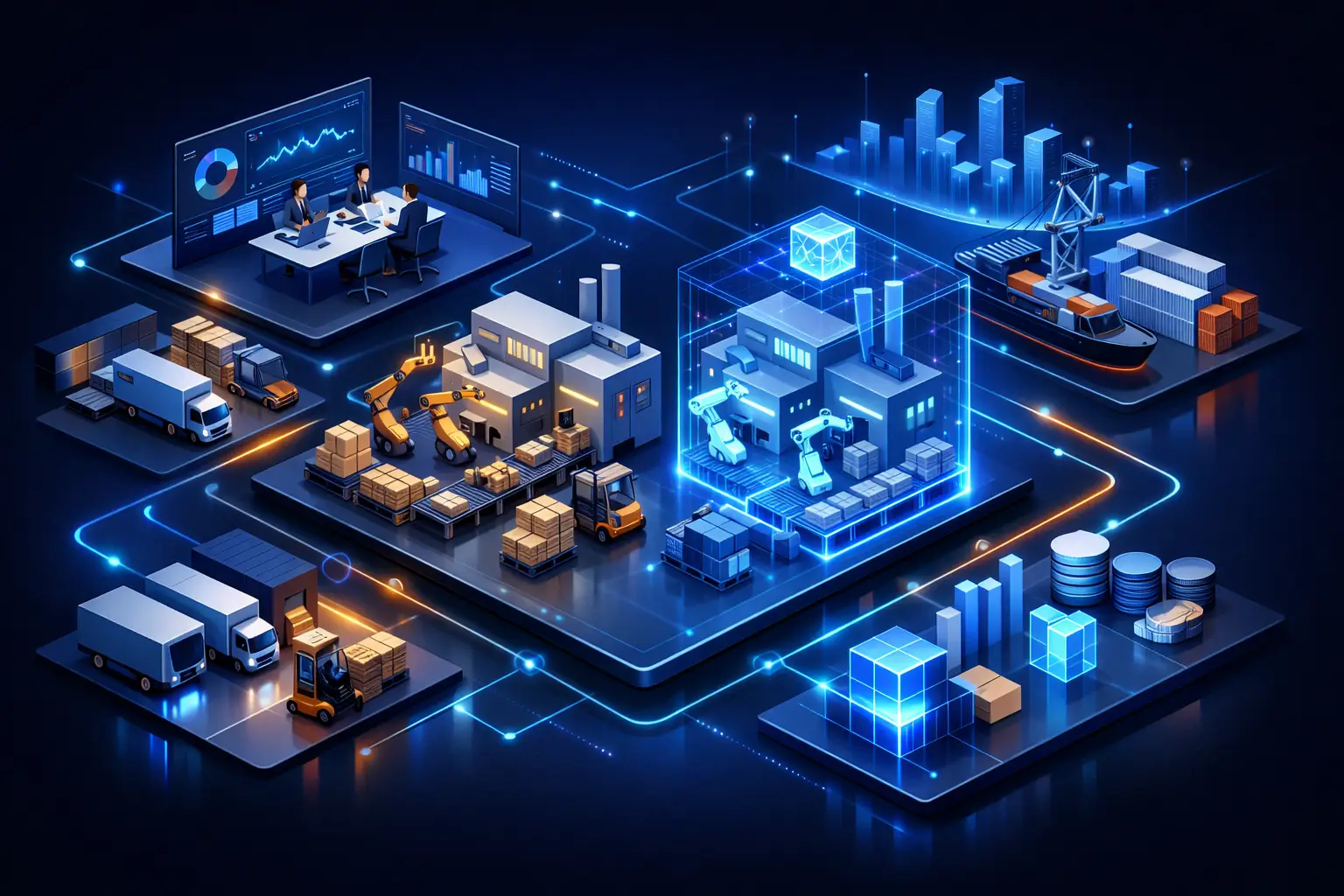
A digital twin is useful when it connects the physical reality—such as a production line, warehouse, fleet, or logistics process—with the associated operational and business data. It's not a one-off report but a model that tracks changes in real operations. This makes a significant difference between a promising technology and actual business results.
The digital twin is increasingly less of a showcase tool
Early digital twin projects often relied on a visual replica of equipment or a plant. The production hall, machine status, and perhaps some metrics were visible on a screen. This can be useful for training, planning, or client presentations, but rarely changes daily operations on its own.
One defining direction today is for the digital twin to become a decision-support operational layer rather than just visualization. The question is not whether the site can be beautifully depicted, but whether a leader or operator can get timely answers to questions like: which machine is limiting output, where is the risk of increased scrap, which orders are affected by a material shortage, or what will be the consequence of a planned shutdown.
The model doesn't necessarily need to include everything. In fact, too broad an initial goal often paralyzes the project. A digital twin of a packaging line can start with three data points: actual cycle time, downtime reason code, and changes in finished goods inventory. If these lead to better shift planning or faster troubleshooting, business value is already created.
Data connectivity is at the heart of digital twin trends
In many organizations, the data is already available. PLCs, SCADA systems, warehouse software, ERPs, maintenance applications, and quality records all collect information. The problem is that this information doesn't mean the same thing, doesn't arrive at the same time, or can't be linked without manual reconciliation.
Therefore, one of the most important trends is not installing new sensors but aligning data from existing systems. For example, a machine's downtime is just a technical event on its own. If it can be linked to the production plan, order priority, parts supply, and maintenance history, its business consequences become visible.
The quality of the connection matters more than the amount of data. If the production system says a product is complete but it can't be received in the warehouse system, the digital twin won't be reliable. First, it's necessary to clarify what "complete" means, who is responsible for the status change, and which system is the authoritative source for the data. This is a process and responsibility issue, only then a technological task.
Real-time data is only valuable if there is a response
Real-time operation often features in the promise of digital twins. However, second-by-second data updates are not always necessary. For a production line's safety or quality deviation, this may be justified. For monthly capacity planning, hourly or daily updates may suffice.
Unnecessarily dense data collection brings cost, complexity, and greater potential for error. A better design question is: what decision needs to be made faster or more accurately, and what fresh data is truly necessary for this? Without a clear answer, a real-time dashboard can easily become just another screen that no one regularly checks.
Simulation: not a prediction, but a verifiable scenario
One of the strongest applications of digital twins is simulation. A company can test in advance what happens if it launches a new product, changes shift schedules, orders from a different supplier, or a key machine unexpectedly fails. This is especially valuable where a bad decision's consequence is not just a few hours of administration but delayed deliveries, overtime, scrap, or lost customer trust.
The quality of the simulation, however, depends on the model's assumptions. If the model assumes ideal machine utilization, while in reality, there are regular changeovers, material shortages, and human capacity constraints, it can provide misleading results. The digital twin does not replace production, logistics, or financial expertise. It uses experts' experience for more structured, verifiable decisions.
In practice, it's worth starting with a specific, recurring problem. For example, a manufacturer cannot provide reliable delivery promises because planners calculate capacity in spreadsheets while the actual machine status and material supply appear late. Here, a narrow digital twin might predict the risk of delays. There's no need to model the entire plant immediately.
The role of AI is more precise than it first appears
Artificial intelligence appears in many digital twin initiatives, but the project doesn't become valuable just by having an AI label. It's worth applying when a large amount of data needs pattern recognition that is difficult to handle with rule-based methods.
This can include early detection of abnormal machine behavior, estimating expected maintenance needs, searching for correlations in quality deviations, or processing information from documents. However, AI does not automatically correct inaccurate master data, missing events, or inconsistent workflows.
If a maintenance event is recorded by one shift as a "mechanical failure," another as a "short stop," and a third as a free-text note, data management needs to be sorted out first. AI can help classify old data here, but the organization must establish common concepts and responsibilities.
Cybersecurity and operational continuity are design issues
As the digital twin connects business systems with operational technology, the number of connection points increases. This is not a reason to delay development, but a reason to ensure architecture is not an afterthought.
It's necessary to define what data can leave the operational network, who can access the model, what logging is required, and what happens in case of a connection outage. A production process should not stop because a central analytics service is temporarily unavailable. The digital twin can support operations but should not create new, hidden dependencies.
A well-constructed solution therefore separates critical control, data collection, and analysis. It manages data permissions and origins, and also how to verify that the model still reflects real operations. This is especially important in regulated industries, but crucial for any company where faulty information can cause direct business loss.
When is it worth considering a digital twin?
Not every process needs a digital twin. For a simple, rarely changing administrative process, clear responsibilities, better system integration, or a few automated steps may yield faster results. A digital twin is justified when operations are complex, variable, involve both physical and digital events, and poor visibility regularly causes costs or risks.
A good sign is if the company regularly tries to understand what happened after the fact. If the weekly performance report is prepared from manual data collection, if production and sales see different inventory numbers, or if the impact of a shutdown can only be assessed days later, the problem may not be a lack of new software. It might be that the flow and interpretation of information need redesign.
The next sensible step is not choosing a platform but tracing a critical process: where does the data originate, who modifies it, which systems does it transfer to, where does it delay, and what decision depends on it. Honest answers to this map already reveal a lot about whether a digital twin is a real development direction or if a simpler operational order needs to be established first.
Planning a similar system or integration?
Show us the current process and systems. We will help identify the lowest-risk next step.
Key Takeaways
- Digital twins are transforming decision-making in manufacturing, logistics, and operations.
- Understanding the practical conditions for implementing digital twins is crucial for success.
- Not all processes require a digital twin; evaluate complexity and risk before implementation.
Frequently Asked Questions
When should you consider using a digital twin?
Not all processes need a digital twin. For simple, infrequently changing administrative processes, clear responsibilities, better system integration, or a few automated steps might yield faster results. A digital twin is justified when operations are complex, variable, involve both physical and digital events, and poor visibility regularly incurs costs or risks.
Related Engineering Insights
7 Steps to Simplify Administrative Processes
Proven steps to simplify administrative processes reduce errors, speed up work, and provide better managerial insights for decision-making.
Process Optimization or Immediate Automation?
Process Optimization or Immediate Automation? Recognize when to first streamline the workflow before choosing technology.
6 Losses in Operations Due to System Failures
The six losses due to system failures often remain hidden: in time, errors, inventory, and lost managerial decision opportunities within the company daily.