Digital Plant Architecture for Growth
Digital plant architecture: how to connect production data, systems, and decisions for predictable operations and better daily management.
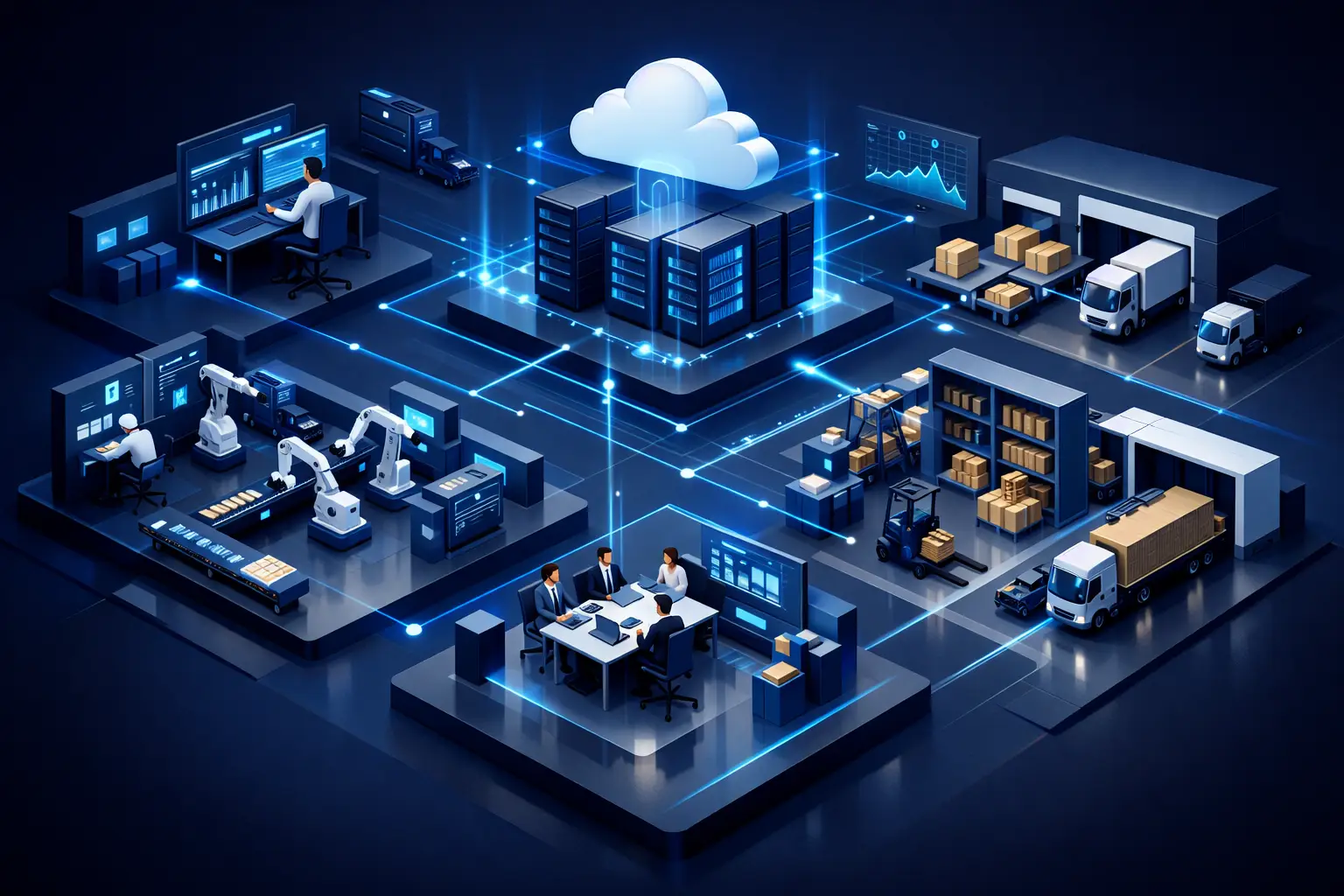
Short Answer
Digital plant architecture connects production data, systems, and decisions for predictable operations and improved daily management.
A production manager reviews the production plan in the morning, the warehouse checks material inventory in another system, quality assurance tracks deviations in Excel, and maintenance receives a phone alert about a shutdown. Every team is working, every system is operational, yet it's challenging to get a single, reliable picture of the plant's status. This is where the business question of digital plant architecturearises.
This is not the name of a new software, nor a display wall in the manufacturing hall. The architecture is the conscious order of where production information originates, who uses it, where it's verified, what decision it supports, and which system needs to pass it on. Properly designed, it reduces uncertainty. Poorly designed, it only produces more data faster than leaders and staff can interpret.
What does digital plant architecture mean in practice?
A plant's digital operation is generally not built on a single system. There are machines and controls, production-supporting applications, inventory and enterprise management systems, quality records, maintenance tools, spreadsheets, and email communications. These have been integrated into operations over time, often for good reasons.
The problem arises when humans perform the integration. Someone copies production data. Someone checks if the materials for an order are actually available. Someone gathers numbers from multiple systems for a management report on a Friday afternoon. In these cases, the employee is not handling exceptions or making decisions but acting as a data link between two systems.
Therefore, digital plant architecture provides an organized answer to four questions: what happens in the plant, what data proves it, where will the data be a reliable record, and who needs to act on it in time. It's not necessary to copy all information into every system. In fact, this often causes new discrepancies. The goal is for every critical piece of data to have a clear source, owner, and usage rule.
Understand the process first
A common mistake is that a company chooses a production tracking system, new ERP module, or machine data collection before accurately mapping out the current work. This leaves existing uncertainties in digital form.
Let's take a simple example. The production plan changes daily because urgent orders, material shortages, and machine downtimes become visible too late. The reflex might be to need a real-time production dashboard. But first, it's worth asking: who can modify the plan and based on what rules? Where does the material shortage first appear? Who is responsible for ensuring the modification reaches the shift, warehouse, and customer relations team?
If there are no clear answers to these, the dashboard only makes the chaos more visible. However, if the process is clarified, technology can support it purposefully: it can signal deviations, update affected systems, and make it visible who made the necessary decision.
During process examination, it's worth paying special attention to points where the same data is recorded multiple times, where handovers occur verbally or via email, and where only one experienced colleague knows the next step. These are not merely efficiency issues. They are also business continuity and quality risks.
The layers of architecture: from machine to management decision
A well-designed system image does not mean that every component communicates directly with everything else. Quite the opposite: it defines boundaries and responsibilities.
At the lowest level, data from physical operations appears: machine status, cycle time, temperature, scrap, energy consumption, or downtime reasons. These are often handled by PLCs, SCADA systems, sensors, or machine-specific software. Not all such data is important from a business perspective, and not all data needs to be stored long-term. Good design starts here by determining which measurements play a role in production management, quality, maintenance, or cost analysis.
The next layer is operational coordination. Here, production orders, shifts, material usage, quality control, and actual performance connect. In some plants, this is supported by an MES system, elsewhere by an existing production application or a specifically developed internal tool. The choice is not an ideological question. A standard system's advantage can be the proven feature set and faster implementation, while a custom solution is justified where the process is truly unique and it would be a competitive disadvantage to impose a general logic.
At the higher business level, ERP, inventory management, procurement, sales, finance, and management reports play a role. Here, it's particularly important that production facts don't appear days later after manual aggregation. Not every event needs to be transferred immediately, but for order status, inventory changes, scrap, or capacity loss, the expected freshness must be defined.
Real-time data is not the answer to every problem
Real-time operation sounds good, but it has costs and consequences. If data changes in seconds, yet the leader uses it for weekly decisions, second-by-second integration doesn't necessarily create proportional value. It may require more infrastructure, supervision, error handling, and security controls.
Conversely, there are situations where delay causes direct loss. If a critical machine shutdown doesn't reach maintenance, if the warehouse sees the material requirement too late, or if production continues unchanged after a quality deviation, then timely alerts have clear business value.
The question is not whether to have as much data as possible. The question is which event requires immediate reaction, which is sufficient for daily processing, and which information serves only analytical purposes. This is a joint decision of data architecture and plant management, not solely an IT task.
Exceptions reveal reality in integration
Many integration plans are prepared for the normal process: order arrives, production starts, product is completed, inventory is updated, invoice can be issued. However, exceptions are just as defining in plants. What happens in case of partial fulfillment? How is scrap handled? What if material needs to be used from another batch? Who approves a subsequent production modification? How does a manual correction get back into the system?
If there are no rules for these, employees bypass the system or maintain their own spreadsheets. This is an understandable reaction because production must continue. In the long run, however, data reliability ceases, and management can only explain what happened after the fact.
Therefore, exception handling is also part of digital plant architecture: it should be visible who modified, why, with what approval, and what business consequence. This is not bureaucracy. It's the basis of traceability, quality assurance, and accountability.
Without security, operation, and change management, there is no lasting result
In a manufacturing environment, a new system cannot stop at the demonstration. It must be defined who supervises data connections, how they receive alerts in case of errors, what backups are made, and how an update can be safely implemented. Special attention is required for the connection between IT and industrial networks: the availability of manufacturing equipment may have different requirements than an office application.
Authorization management is also an operational issue. A shift leader may need to modify a plan but doesn't need access to financial data. Maintenance needs to see machine status, but modifying certain parameters should only be allowed for designated personnel. The architecture works well when these authorizations follow real responsibilities, not randomly established system accounts.
At implementation, it's generally safer to start with a well-defined, measurable area. For example, by standardizing downtime data for a group of machines, making a material request process transparent, or eliminating manual data transfer between production completion and inventory. Such a step reveals data quality, responsibility, and operational issues before the change extends to the entire plant.
Ultimately, a good digital architecture is valuable not because of how many systems it consists of. It's valuable because a shift leader, a warehouse worker, and a CEO receive an appropriate, usable picture of the same operation. Therefore, before the next development idea, it's worth asking not what technology to implement, but which decision lacks reliable information today, and what prevents it from reaching where it's needed in time?
Planning a similar system or integration?
Show us the current process and systems. We will help identify the lowest-risk next step.
Key Takeaways
- Digital plant architecture integrates production data and systems for enhanced operational predictability.
- It supports better daily management by streamlining decision-making processes.
- The architecture involves various systems like machines, control systems, and management tools.
Frequently Asked Questions
What does digital plant architecture mean in practice?
A plant's digital operation typically doesn't rely on a single system. It includes machines and controls, production support applications, inventory and enterprise management systems, quality records, maintenance tools, spreadsheets, and email communications. These have been integrated over time, often for good reasons.
Related Engineering Insights
Establishing an Internal Approval Process
Establishing an internal approval process clarifies decision-making authority, reduces delays, and provides more reliable operations for a growing company today.
How to Assess Administrative Burdens?
Here's how we assess administrative burdens: we identify repetitive tasks, sources of errors, and processes that slow down growth precisely within the company.
Custom Software or Spreadsheet? When to Choose Which
Custom software or spreadsheet? We show you how to assess the process, risks, and growth needs before responsibly choosing a system in a timely manner.