Custom Software vs Off the Shelf: Which is Better?
A warehouse doesn't halt operations because the software is "not ideal," but because there's no room for maneuver in a critical process. In such cases, the custom software vs off the shelf question is not a procurement preference but an operational,
Short Answer
A warehouse doesn't halt operations because the software is "not ideal," but because there's no room for maneuver in a critical process. In such cases, the custom software vs off the shelf question is not a procurement preference but an operational decision.
A warehouse doesn't shut down because the software is "not ideal," but because there's no room for maneuver in a critical process. In such cases, the custom software vs off the shelf question is not a procurement preference but an operational, risk management, and governance decision. The choice directly impacts availability, integrability, compliance, and how well the company can manage its operational logic.
Many organizations initially turn to off-the-shelf solutions because they seem quicker to implement, cheaper, and less risky. This is true in certain situations. But when a company's operations depend on the coordinated collaboration of multiple systems, sites, automated tools, ERP, WMS, manufacturing, and logistics, the limitations of a ready-made product quickly become apparent. The decision doesn't fail where the demo looked good, but where real processes differ from general software logic.
What does custom software vs off the shelf really mean?
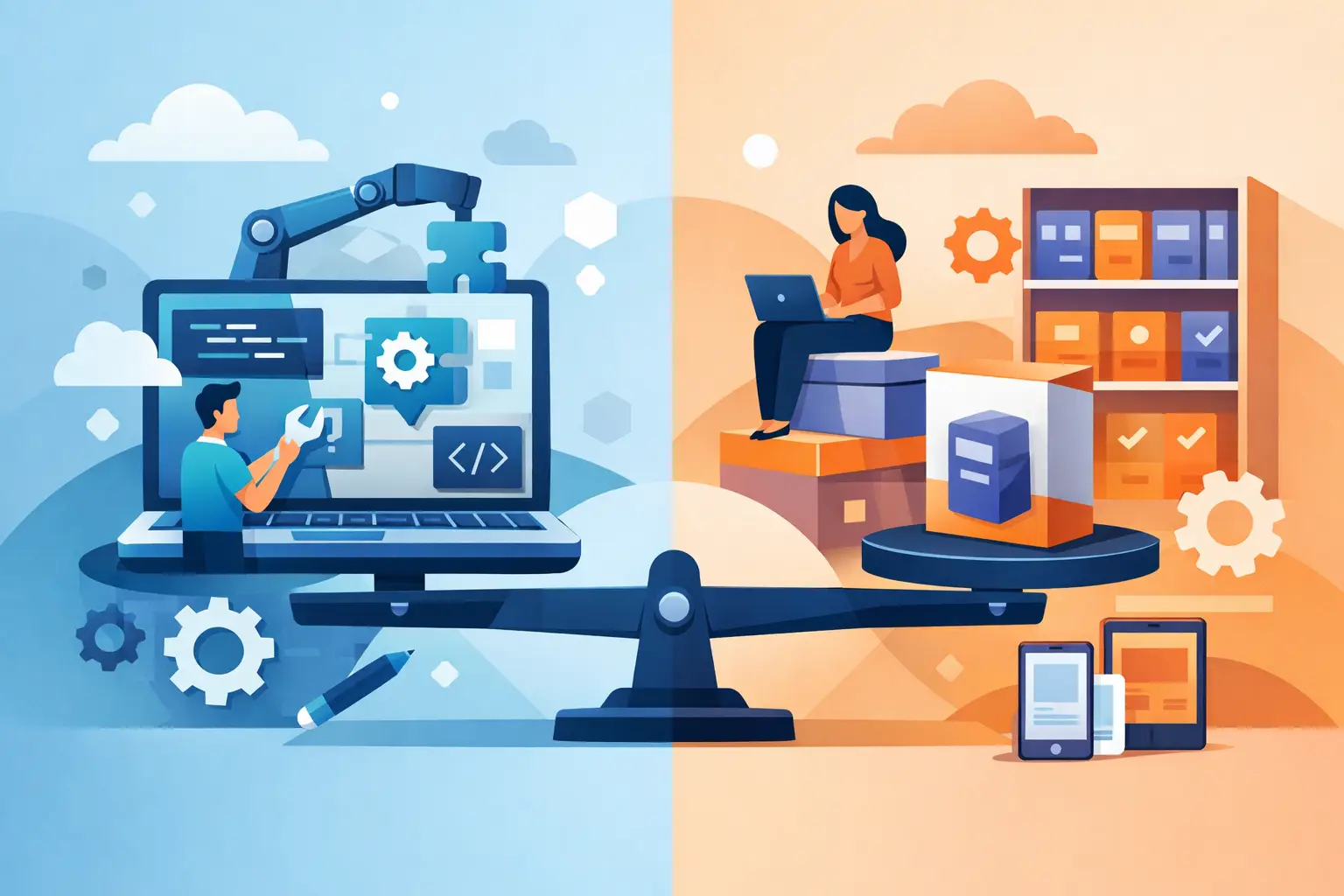
Off-the-shelf software is a pre-made product. It is designed for a broad market, addresses recurring business needs, and can typically be customized with configurations, modules, or plugins. Its advantage is that most features are immediately available, the manufacturer maintains the product, and the initial entry threshold is often lower.
Custom software, on the other hand, is a targeted system. It is not designed for the general market but for a specific organization's operational model, governance logic, integration environment, and compliance requirements. Its value lies not in being "unique," but in aligning with the company's critical processes, not the other way around.
The decision is often oversimplified to a cost issue. This is misleading. The real question is whether the software should serve the operation or the operation should adapt to the software. If the latter incurs too high organizational, operational, or compliance costs, the seemingly cheaper system will ultimately be more expensive.
When is a ready-made system a good choice?
Ready-made software works well when a company's processes are close to industry standards and there is no need for deep inter-system or machine-level integration. A typical example is a well-defined support function where differentiation lies not in software logic but in business execution.
In such cases, the advantage is that the product can be quickly tested, implemented, and the manufacturer usually works with a known update cycle. If the organization can accept the product's operational framework, standardization can even be beneficial. It can reduce local variations, simplify user support, and reduce investment needs in the short term.
The problem begins when too many workarounds are built into the ready-made system. Custom exports, manual data corrections, intermediate tables, external scripting, API bridges, and operator exceptions appear. These initially seem like small compromises but later cause unstable architecture, difficult-to-audit operations, and unpredictable operational burdens.
When is custom development justified?
Custom development is justified when a company's operations cannot be replaced by a general pattern. This is especially true where multiple business and operational systems need to work together in real-time or near real-time, and the margin for error is small.
In manufacturing, logistics, e-commerce, or integrated enterprise management environments, it is common for competitive advantage to stem not from a single function but from disciplined collaboration between systems. If the ready-made software can only partially follow this, someone has to build the missing layer. In such cases, it is often more practical to design a controlled, architecturally validated custom system from the start than to patch the shortcomings of a ready-made product.
Another typical case for custom development is compliance and governance. If an organization has strict logging, authorization management, data handling, validation, or availability requirements, it is not enough for the software to "roughly know" the necessary function. It is important that it can do so demonstrably, auditable, and operable.
Total cost of ownership is more important than entry price
In the custom software vs off the shelf debate, initial license or development costs receive too much attention. At the management level, it is worth looking at the total cost of ownership. This includes implementation, integration, change management, training, operation, downtime costs, vendor lock-in, modification costs, and the loss caused by system limitations.
A ready-made product may be cheap in the first year but can become expensive due to customizations, licenses, external extensions, and manufacturer constraints. In contrast, a well-designed custom system may require a higher initial investment but can provide more predictable control over changes, operations, and integration.
Not every custom development is a good investment. Without clear architecture, governance, version discipline, and responsible technical management, a custom system can quickly become technical debt. The question is not whether to choose custom or ready-made, but whether there is engineering discipline behind the chosen model.
Integration, availability, governance
In most companies, software value is not in a single application but in how it connects to other elements of the environment. ERP, WMS, MES, webshop, transport systems, finance, supplier data connections, and industrial control layers together form the operational chain. If a ready-made system only partially fits into this chain, the entire process can become more vulnerable.
The advantage of custom development here is not freedom but deterministic fitting. Data movement, error handling, authorizations, transaction boundaries, and fallback mechanisms can be planned. This is especially important where downtime is not just an inconvenience but a direct revenue, production, or compliance risk.
In a governance-first approach, the software decision cannot be separated from infrastructure and operations. It is not enough for a system to functionally comply. It must be known how it updates, how it can be monitored, how it recovers from errors, how it can be audited, and to what extent it depends on an external manufacturer's schedule.
How should one decide on custom software vs off the shelf?
First, it must be clarified whether the process in question is of strategic importance. If the system directly impacts revenue, manufacturing continuity, order fulfillment, or compliance, the decision should not be handled purely with procurement logic.
Next, it is worth assessing how unique the operational model is. If the company's processes are truly standard, the ready-made product may be a good choice. However, if the business value comes from its own operational logic, quick responsiveness, or coordination of multiple systems, the ready-made software will likely only be a partial solution.
The third aspect is the depth of integration. The more critical systems need to work together, the more important the architecture becomes. Here, it is not functions but system boundaries, data pathways, availability expectations, and change management risks that need to be examined.
Finally, it must be decided how much control the organization wants over its digital operations. Many companies are satisfied with the ready-made product as long as the manufacturer's roadmap and business needs align. When this ceases, the cost of flexibility suddenly increases.
Not every system needs to be custom-built
The most mature approach is rarely black and white. For many organizations, the right direction is a hybrid model: where the process is commoditized, a ready-made system; where the operation is critical, integration-intensive, or carries a competitive advantage, a custom component or custom control layer. This reduces unnecessary development while maintaining control where it truly matters.
Such decisions require architectural judgment, not developer capacity. The goal is not for everything to be custom but for the system environment to remain predictable, sustainable, and reliable. In this mindset, software is not a standalone procurement but a regulated element of the operational chain.
When facing a choice, it is worth not asking which option seems faster, but which maintains control over operations even when the load increases, exceptions multiply, and the system must perform not in a demo but in operation.
Planning a similar system or integration?
Show us the current process and systems. We will help identify the lowest-risk next step.
Key Takeaways
- Custom software aligns with specific operational models, while off-the-shelf solutions cater to general market needs.
- Off-the-shelf software is quicker to implement but may require costly customizations for complex operations.
- Custom development is justified when operations cannot fit a general template, requiring real-time system cooperation.
- Total cost of ownership, including integration and change management, is crucial in software decisions.
- A hybrid model, using both custom and off-the-shelf solutions, can offer control and reduce unnecessary development.
Frequently Asked Questions
When is off-the-shelf software a good choice?
Off-the-shelf software is suitable when company processes align with industry standards and do not require deep integration.
Why choose custom software?
Custom software is ideal when a company's operations are unique and require specific system cooperation and compliance.
What factors should be considered in software decisions?
Consider strategic importance, uniqueness of operations, integration depth, and desired control over digital operations.
Related Engineering Insights
Automating Reporting for Executive Decisions
Automating reporting for executive decisions: less manual data collection, clearer indicators, faster and more verifiable executive decisions in practice.
Unifying Dispersed Business Data in Practice
Unifying dispersed business data doesn't start with a new system. First, uncover the data's path, the errors, and the manual steps that slow decision-making.
Reducing Manual Data Entry in Companies
Reducing manual data entry in companies is not just about automation: it leads to clearer processes, fewer errors, and more reliable decisions.