Cloud or Hybrid Infrastructure for Enterprises
The shutdown of a production system, warehouse management platform, or online sales environment is not an infrastructure debate but a direct business risk. The question of cloud or hybrid infrastructure should be decided based on business processes, data flow, regulatory obligations, and recovery expectations, not provider preference.
Short Answer
The shutdown of a production system, warehouse management platform, or online sales environment is not an infrastructure debate but a direct business risk. The question of cloud or hybrid infrastructure should be decided based on business processes, data flow, regulatory obligations, and recovery expectations, not provider preference.
The downtime of a production system, warehouse management platform, or online sales environment is not an infrastructure debate but a direct business risk. The question of cloud or hybrid infrastructure should be decided based on the criticality of business processes, data flow, regulatory obligations, and recovery expectations, not provider preference. A poor decision can result not only in higher IT costs but also in production loss, incorrect inventory data, delivery delays, or unauditable operations.
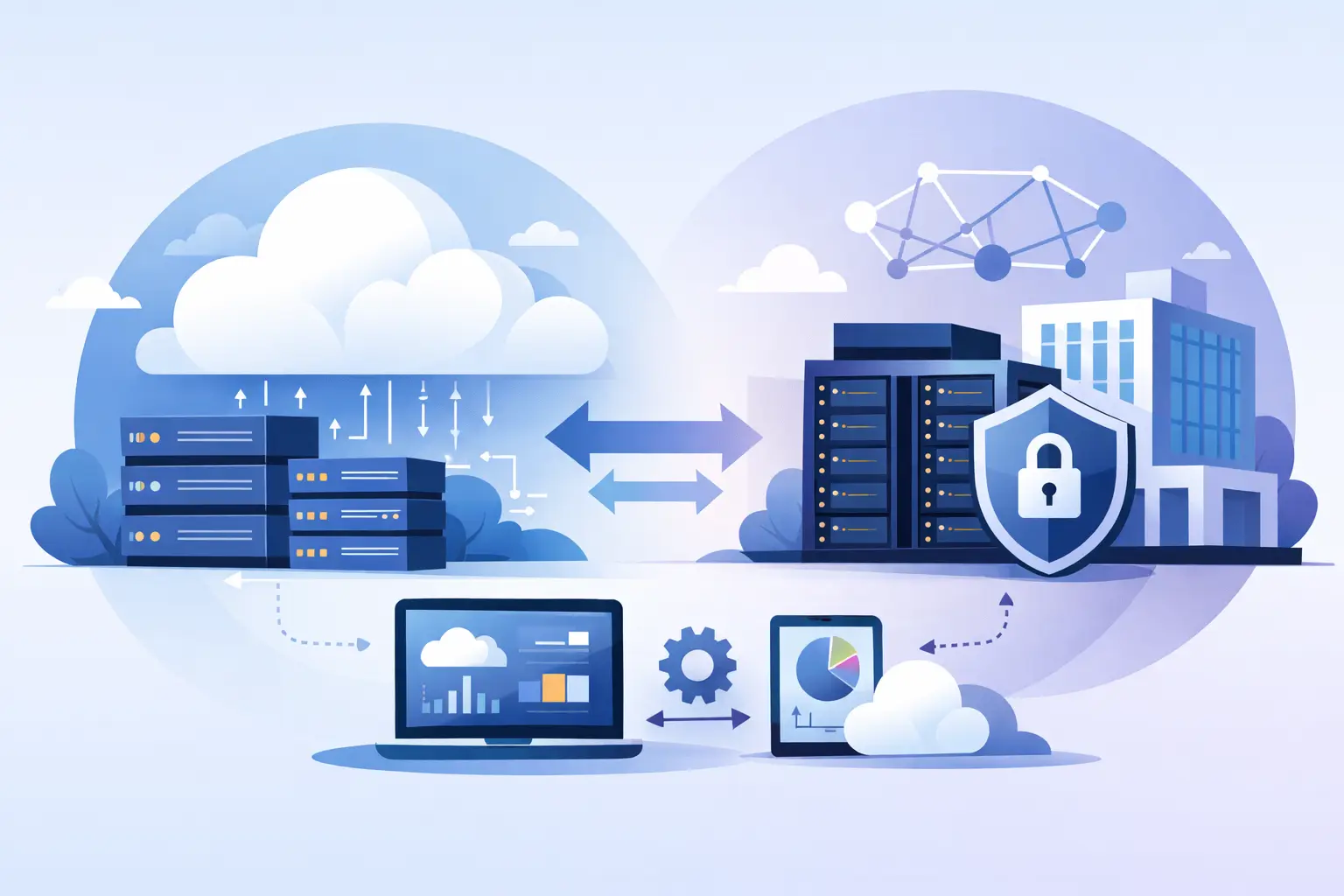
The decision is rarely binary. Pure public cloud, private data center, and hybrid models present different risk profiles, operational responsibilities, and planning disciplines. In a corporate environment, a defendable architecture is created when load patterns, dependencies, data lifecycle, and recovery objectives are considered within the same decision framework.
Starting point of the decision: business continuity
Most infrastructure programs start with technology too early. Questions arise about which cloud platform, region, or container solution should be standard, while fundamental questions remain unresolved: which processes cannot stop, how much data loss is acceptable, and how quickly must the service be restored.
These two metrics clearly define it. RTO, or recovery time objective, determines how long a system can be down. RPO, or recovery point objective, shows how much data loss is tolerable. A daily reporting system might have an acceptable RTO of several hours, but for a manufacturing control, order processing, or warehouse transaction environment, this could be commercially unacceptable.
Moreover, critical services rarely operate independently. Real-time or near-real-time integrations run between ERP, WMS, e-commerce platforms, carrier connections, customer databases, manufacturing execution systems, and identity management. Moving a component to the cloud does not automatically mean more modern operations if the latency, network dependencies, or fault tolerance of related systems are not redesigned.
When is public cloud justified?
Public cloud offers real advantages when an organization utilizes elastic capacity, geographic distribution, standardized managed services, and automated operations. In cases of e-commerce peak periods, fluctuating analytical loads, digital customer channels, or rapidly growing application portfolios, flexible scaling of capacity is also justifiable from a business perspective.
However, the cloud does not absolve the company of architectural responsibility. The provider is responsible for part of the physical infrastructure, but identities, permissions, network segmentation, application configurations, backups, and data protection rules remain under the company's control. Misunderstanding the shared responsibility model is one of the most common reasons a fast-starting cloud project later becomes a security, cost, or compliance issue.
Public cloud can be an especially good choice if the application can be designed in a stateless manner, services are well-automated, and data placement does not conflict with strict legal or contractual constraints. In such cases, the cloud is not just a new hosting location but a shift in operational models.
Cloud cost is not just consumption fees
The cloud cost model can make initial investments more predictable but does not guarantee lower total lifecycle costs. Persistently high loads, data egress fees, oversized resources, uncontrolled development environments, and concurrently running, forgotten services can quickly build up operational bills.
Therefore, financial control must be part of the architecture. Without tagging standards, ownership responsibility, cost frameworks, capacity planning, and regular optimization, the cloud can easily become a decentralized procurement channel. This is not a technological error but a lack of governance.
Hybrid infrastructure: control at critical boundaries
Hybrid infrastructure is not a transitional state and not proof of failure to move to the cloud. When well-designed, it is a target architecture that places workloads in execution environments that meet their technical and business requirements.
In a manufacturing plant, for example, systems related to industrial controllers, local machine data, or low-latency processes may be justified to remain on-site. Meanwhile, central analysis, reporting, demand forecasting, partner portals, or document management can run in the cloud. The boundary is not determined by whether an application is old or new but by the latency, availability, data sovereignty, and integration requirements it carries.
The value of the hybrid model is particularly significant when a company needs to connect existing, stable legacy systems with new digital capabilities. It is not necessary to replace all systems at once to improve data flow, observability, or disaster recovery. Gradual modernization can reduce operational risk, provided the interim architecture does not become a permanent collection of undocumented exceptions.
The price of a hybrid environment is complexity
Hybrid infrastructure only works reliably if the fundamental controls are unified across the two or more environments. This includes identity management, permission models, logging, encryption, network regulation, configuration management, and monitoring. If these differ by environment, the hybrid model produces invisible operational risks rather than flexibility.
Data movement requires special attention. It is not enough to determine that data can technically be transferred. The data owner, classification, retention period, processing purpose, and location of copies must also be known. An integration is controlled if it can be traced back, rerun in case of error, and does not cause inconsistency in business systems.
Cloud or hybrid infrastructure is a governance issue
The quality of the decision ultimately depends on who has control over the architecture.With the presence of multiple business units, external developers, SaaS providers, and infrastructure partners, an environment can easily develop where no one sees the full dependencies and risks.
Governance is not slowing administration. It is a decision and control system that determines who approves a new connection, what security minimums apply, how change management occurs, who tests recovery, and who takes responsibility in case of an incident. In critical environments, the answers to these questions cannot remain as project knowledge or in the mind of a single key person.
In the right operating model, infrastructure can be managed in code form, versioned, and auditable. Deployments are repeatable, configuration discrepancies can be identified, access can be time-limited, and changes reach the live environment through an approval chain. This creates a balance between faster delivery and disciplined operations.
Architectural validation is necessary before making a decision
A cloud strategy begins not with a presentation but with exploration. The company must first create a service map: which applications support critical business processes, what interfaces they communicate through, what data they handle, and what infrastructure dependencies they have. This is followed by risk classification and target state planning.
During validation, it is worth separately addressing technical feasibility and operational suitability. A system may be technically migratable, but due to manufacturer support conditions, licensing, network latency, or recovery expectations, its migration may not be justified from a business perspective. Similarly, a locally retained system may be acceptable if its backup, redundancy, and lifecycle management demonstrably meet the required level.
In CGAT's approach, infrastructure direction is not an isolated platform decision but part of the integrity of the entire operational system. The goal is not to maximize cloud usage but to ensure every critical component operates in a controlled, documented, and recoverable environment.
The correct choice is not determined by whether the cloud or hybrid model seems more modern. A defendable infrastructure is one that maintains control over business operations during an error, change, or unexpected load peak.
Planning a similar system or integration?
Show us the current process and systems. We will help identify the lowest-risk next step.
Key Takeaways
- The decision between cloud and hybrid infrastructure should be based on business processes, data flow, regulatory obligations, and recovery expectations.
- Public cloud offers advantages like elastic capacity and automated operations but requires careful architectural responsibility.
- Hybrid infrastructure provides control at critical boundaries and is not merely a transitional state.
- Governance is crucial in managing cloud or hybrid infrastructure to ensure security, compliance, and operational efficiency.
- Architectural validation and a clear service map are essential before deciding on cloud strategy.
Frequently Asked Questions
What factors should influence the decision between cloud and hybrid infrastructure?
The decision should be based on business processes, data flow, regulatory obligations, and recovery expectations.
When is the public cloud advantageous for a company?
The public cloud is advantageous when an organization can leverage elastic capacity, geographic distribution, and automated operations.
Why is governance important in cloud or hybrid infrastructure?
Governance ensures security, compliance, and operational efficiency by defining decision and control systems for infrastructure management.
Related Engineering Insights
Unifying Dispersed Business Data in Practice
Unifying dispersed business data doesn't start with a new system. First, uncover the data's path, the errors, and the manual steps that slow decision-making.
Reducing Manual Data Entry in Companies
Reducing manual data entry in companies is not just about automation: it leads to clearer processes, fewer errors, and more reliable decisions.
Step-by-Step Mapping of Business Processes
Step-by-step mapping of business processes reveals where time, data, and responsibility are lost, ensuring more stable operations in practice.