Barcode or RFID in the Warehouse - Which is Worth It?
Barcode or RFID in the warehouse? The right choice depends not on the technology, but on the precise analysis of goods movement, data, and error costs in the warehouse.
Short Answer
Choosing between barcode and RFID in the warehouse depends on analyzing goods movement, data, and error costs rather than just the technology itself.
The picker notes the shortage on paper, and at the end of the shift, someone updates it in the system. Physically, the goods are already in a different location than where the inventory records indicate they should be. Meanwhile, an urgent webshop order arrives, and the warehouse manager tries to determine over the phone what is actually available. The question often sounds like this: barcode or RFID in the warehouse?
The correct answer is rarely the name of the technology itself. First, it is necessary to understand where the movement of goods, administration, and inventory information diverge. A well-functioning barcode process is more accurate and economical for many companies than a poorly planned RFID implementation. In other cases, RFID eliminates the manual verification burden that hinders growth.
Examine the process, not the label first
The warehouse identification problem often doesn't start with the lack of a proper reader. Rather, it starts with the steps of receiving, storing, relocating, picking, and shipping goods not being clearly linked to the records.
For example, it may happen that the incoming goods are labeled by a colleague but only recorded in the system later. Or inventory movement is scanned on a handheld terminal, and then someone separately records the location in a spreadsheet. In such cases, technology becomes just another data source rather than the sole record, leading to more work, reports from different data, and debates over which number to trust.
Before choosing a barcode or RFID, it is worth tracing the path of a specific item: when the information arrives, who records it, who verifies it, where the inventory location changes, and from which system the invoice, shipping task, or management report will be generated. This is not a theoretical exercise. It reveals whether the identification is truly slow or if the responsibilities, system connections, and exception handling are uncertain.
What can a barcode do well in the warehouse?
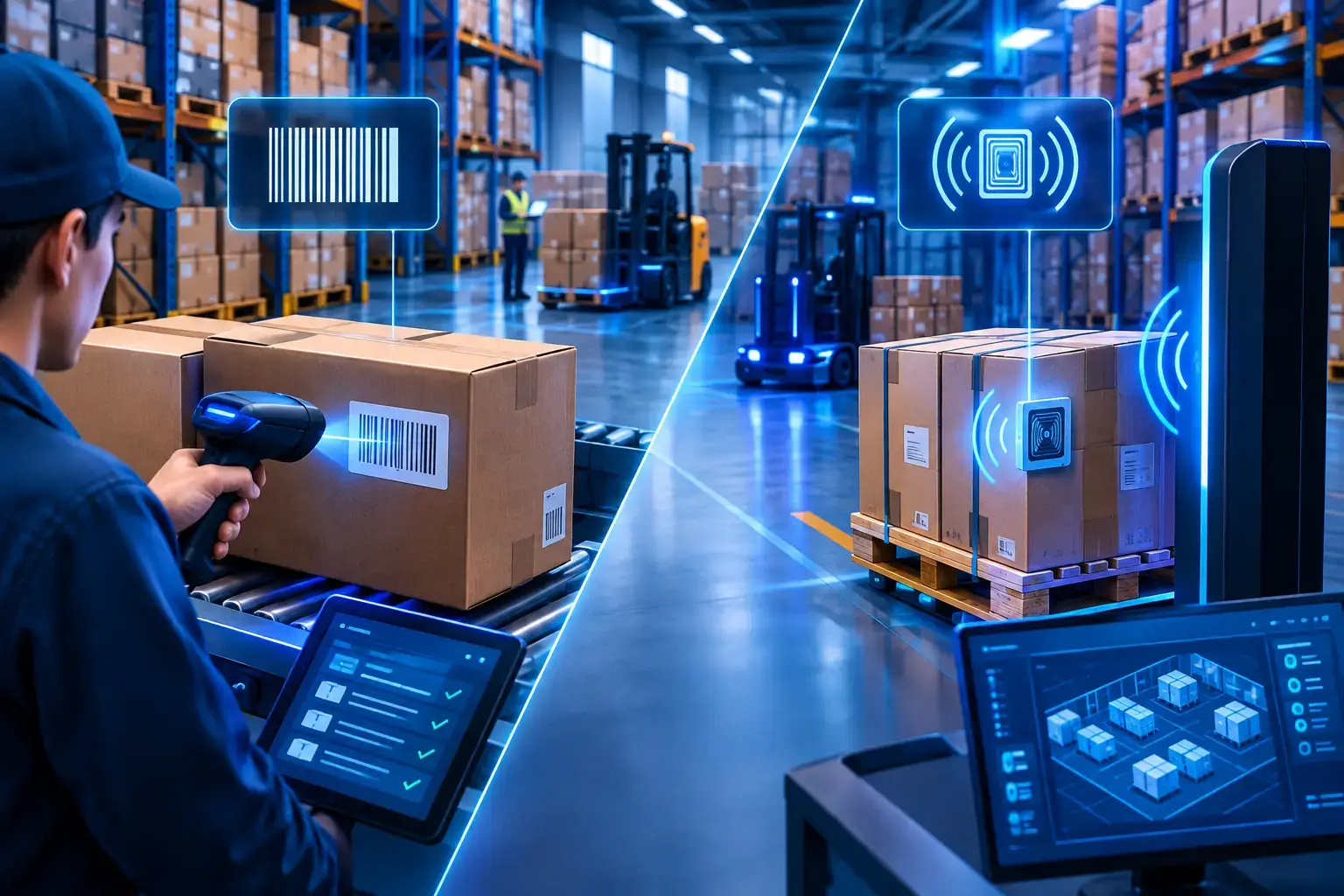
A barcode is essentially a visually printable identifier. The worker scans the label with a reader or mobile device, and the system identifies the product, production batch, pallet, or storage location associated with the code. The solution is well-known, inexpensive, easy to understand, and can be connected to various warehouse systems.
Its greatest advantage is the disciplined, visible work step. The worker scans the goods and location one by one, allowing the system to accurately record when, by whom, and with what device a particular operation occurred. This is especially useful when an item, box, or pallet needs to be handled unambiguously, and human verification is inherently required in the process.
A barcode can be a good choice if the products are relatively clean, the labels accessible, operations occur at the piece or box level, and the volume of goods passing through does not make individual scanning disproportionately slow. In many companies with 20-500 employees, the main constraint is not the scanning speed but that the scanned data does not automatically reach the next point in the inventory, order, or billing process.
The limitation of a barcode is that it requires direct visibility. The label must be readable, the worker must find it, and generally, it must be read individually. Damaged, dirty, or poorly placed labels increase exception handling. If hundreds of pallets or packages containing numerous items pass through a gate hourly, individual scanning can cause operational congestion.
When is RFID justified?
An RFID tag uses radio frequency identification. It does not require direct visibility of each label, and with proper setup, multiple tags can be read simultaneously. This does not mean that RFID is automatically more accurate in every environment. It means it enables a different type of data collection.
RFID can yield significant results if a company needs to quickly and in larger quantities identify moving assets, pallets, crates, or returnable packaging. A typical situation is when entire pallet units need to be verified before shipping or when missing transport equipment ties up significant capital. It can also be justified if manual inventory regularly disrupts operations and inventory accuracy poses a business risk.
However, RFID is not merely a more expensive barcode. It requires tags, readers, antennas, a physical installation plan, data processing, and operational testing. Metal surfaces, liquids, densely stacked goods, packaging materials, and the physical design of gates can all affect reading results. A demonstration working in an office does not prove that the system will be reliable in the actual loading environment.
Therefore, validation is a central issue in an RFID project. It is essential to define what constitutes a successful read event, what error rate is acceptable, how multiple reads are handled, and what happens if a tag cannot be read. Without these, RFID remains a spectacular technology but will not become a controllable operational process.
Barcode or RFID in the warehouse: the real decision criteria
The decision should be approached from the perspective of the operation's cost and the consequence of errors. The question is not which technology is more modern, but where losses occur today.
If incorrect inventory information only costs the team a few minutes, a different solution is warranted than if the error halts production, delays shipping, or incurs penalties. If workers spend several hours daily on manual searching and verification, it must be measured whether this is truly caused by individual scanning. It may be that the storage logic, labeling rules, or delay between the system and physical process is the main problem.
The following questions help clarify the situation:
- What unit needs to be identified: individual product, box, pallet, asset, or packaging?
- How many movements occur daily, and which of these truly require immediate recording?
- What business damage is caused by incorrect, late, or missing inventory data?
- Is automatic identification of multiple items at once necessary?
- Which system will be the authoritative source of data, and how will the event reach it?
- Can the warehouse team safely handle exceptions during the shift?
The list is not a procurement specification. It serves to distinguish the real operational need from the technological assumption.
The path of data is at least as important as the reading
A warehouse identification development creates control when the event from scanning reaches the appropriate business decisions. If the status of a picked order immediately appears in order management, transport planning, and management reporting, it reduces reconciliation. If the same data must be manually transferred in three places, the best reader will not solve the fundamental problem.
Exceptions also require special attention. Damaged labels, partial shipments, returns, incorrect storage locations, consolidated or split pallets occur in every warehouse. A good process does not assume there will be no errors but provides quick and traceable handling for them. The worker must know what to do, and the manager must see where and how often discrepancies occur.
In many cases, the best solution is hybrid. The barcode remains for product or box-level, directed operations, while RFID tracks the movement of high-value assets, pallets, or returnable packaging materials. This way, automation is placed where it truly relieves the team, not where it only creates new operational risks.
Therefore, it is worth starting the technology decision with a smaller, measurable operational trial. Choose a goods movement where the current time investment, error rate, and delay are known. Measure the result under real conditions, and only then develop the full warehouse standard. Good warehouse identification is ultimately valuable not because there is RFID or a barcode on the label, but because the company can reliably know at any time: what is in stock, where it is, what happened to it, and what the next responsible step is.
Planning a similar system or integration?
Show us the current process and systems. We will help identify the lowest-risk next step.
Key Takeaways
- Identify what needs to be tracked: individual products, boxes, pallets, equipment, or containers.
- Determine how many movements occur daily and which require immediate recording.
- Assess the business impact of incorrect, delayed, or missing inventory data.
- Consider if automatic identification of multiple items simultaneously is necessary.
- Decide which system will be the authoritative source of data and how events are communicated to it.
Frequently Asked Questions
What are the advantages of barcodes in the warehouse?
A barcode is essentially a visually printable identifier. An employee scans the label with a reader or mobile device, and the system identifies the product, batch, pallet, or storage location associated with the code. This solution is well-known, cost-effective, easy to understand, and compatible with various warehouse systems.
When is RFID justified?
An RFID tag uses radio frequency identification. There is no need for direct line of sight to each tag, and with proper setup, multiple tags can be read simultaneously. This does not mean RFID is automatically more accurate in every environment; it enables different types of data collection.
Related Engineering Insights
AI-Based Document Processing in Practice
AI-based document processing can reduce administration and errors if the entire document process is organized and verifiable beforehand.
How to Manage System Downtime Incidents
Here's how we manage system downtime incidents: clear responsibilities, rapid recovery, precise communication, and fewer recurring errors in the long term.
How to Measure Manufacturing Lead Time?
How to measure manufacturing lead time? Accurate definitions, data sources, and indicators to uncover delays, waiting times, and bottlenecks.