Automation or Workstation Development?
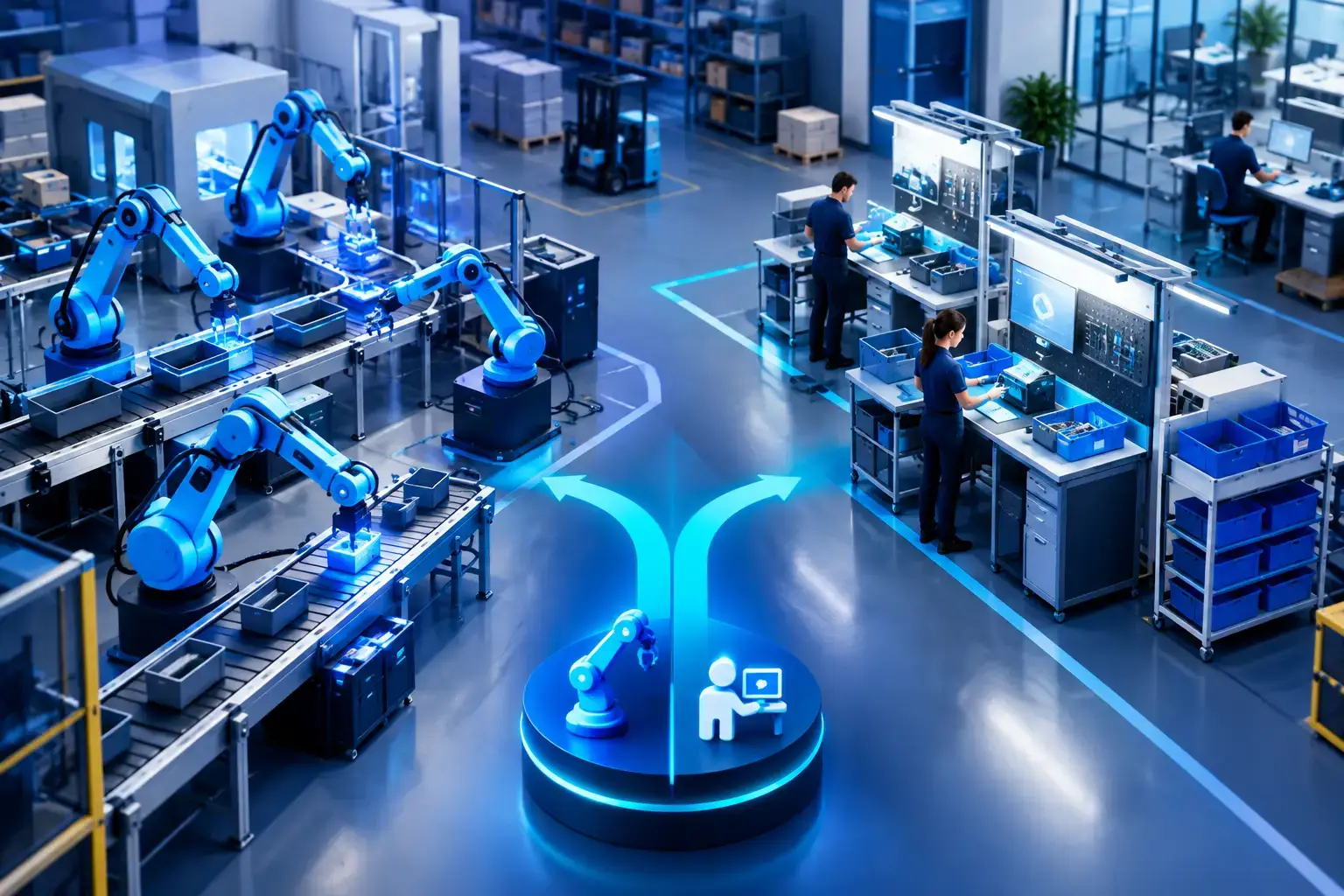
Automation or workstation development: to make the right decision, it's crucial to accurately assess the process, losses, and human roles in a timely manner.
Short Answer
To decide between automation and workstation development, it's essential to accurately evaluate the process, losses, and human roles in a timely manner.
In the morning, the shift supervisor walks through the production area because the system does not clearly indicate the status of each workstation. At one machine, materials are waiting, at another, a colleague is searching for the next instruction on paper, and at a third, work is halted awaiting approval. In such a situation, robotization or workstation development is not merely a matter of investment. First, it's essential to understand what truly hinders the flow.
A robot may seem like an impressive solution, especially when the plant is burdened by labor shortages, repetitive manual tasks, or increasing order volumes. However, a poorly organized process is only executed faster by a robot. If material information is incomplete, if the production sequence changes daily in Excel, or if quality control results reach the next step too late, the problem is not solely about physical labor.
First, identify the loss
The decision does not start with which robot to purchase or what display to install at the workstation. It begins with whether management and the shift can accurately identify where time, capacity, and information are lost.
At a manufacturing company, for example, the utilization of the welding station may appear low. The initial conclusion is often that more automation is needed. However, a detailed examination may reveal that welding itself is not slow: the arrival of prepared workpieces is unpredictable, program selection is manual, and there is no clear rule for accepting finished pieces. In this case, a new robot cell may not be the best first step.
Typical losses are often less visible than a stopped machine. These include waiting for approval or materials, repeated data entry, searching for paper-based work instructions, using incorrect versions, unnecessary material handling, and manual status reporting. Together, these tie up significant capacity while appearing to be part of daily operations.
Therefore, the right question is not "which technology is more modern?" but "which change eliminates the most recurring losses with the least operational risk?"
When is workstation development justified?
Workstation development can be a strong starting point when the person performing the work has the necessary expertise but lacks the appropriate information, tools, material supply, or feedback. In such cases, the goal is not to replace human labor but to ensure the colleague is not simultaneously an administrator, information seeker, and error corrector.
A well-designed workstation clarifies the next task, what materials and tools are needed, which product version is being produced, what quality checks need to be performed, and where the finished workpiece goes. This can be a simple physical rearrangement, standardized stock location, barcode identification, digital work instructions, or a terminal displaying the relevant data from the production system.
Development is particularly useful if a significant portion of errors stems from version control, ambiguous instructions, or training new colleagues. An experienced worker often mentally assembles how to handle exceptions. This works in the short term, but the company becomes vulnerable to individual knowledge. If the person is on leave, sick, or assigned another task, the process can immediately slow down.
The advantage of workstation development is that it can typically be introduced in smaller steps and validated more quickly. During a pilot, throughput time, scrap, training time, or daily performance fluctuations can be measured. It does not always require a large system implementation but yields lasting results if the underlying information sources are also organized.
A digital display alone is not development
A common mistake is simply replacing paper work instructions with a screen. If the screen displays outdated, incomplete, or difficult-to-interpret information, the problem remains. The value of digitalization is not in the display but in delivering the right data to the right person at the right time.
Therefore, it's worth clarifying the data owner, approval of modifications, and which system the workstation receives instructions from. Otherwise, production, quality, and planning may continue to work from different information, only now in digital form.
When is robotization justified?
Robotization creates real business value when the task is repetitive, sufficiently stable, well-defined, and measurable. Typical examples include palletizing, material handling, machine tending, screwing, welding, or some repetitive inspection tasks. In these cases, the robot can increase capacity, improve consistency, and reduce the proportion of physically demanding work.
However, stability is a key issue. If a product arrives in multiple variations daily, workpiece positions vary, preparation is non-standard, or there are many exceptional cases, integrating a robot cell can be more complex and costly than the initial business plan suggests. It's not impossible, but the investment must also address variability, changeover times, and exception handling.
The robot's environment must also be examined. Who supplies it with materials? What happens in case of an error signal? How is quality feedback provided? Where does the production data go? Is there a maintenance and spare parts plan? A robot cell is not an isolated island but part of an operational process. If the associated manual steps are not clarified, the bottleneck simply moves in front of or behind the cell.
Robotization or workstation development: often not either-or
In many cases, the right development sequence starts with organizing the workstation and process, followed by robotization. Standardized material supply, precise workpiece identification, clear production sequence, and reliable feedback not only facilitate human work. They also provide the operational discipline and data quality on which an automated solution can be safely built.
In other situations, robotization may be the first justified step. For example, when a task in a hazardous, ergonomically unfavorable, or permanently unfillable position is clearly repetitive. Here, it is not advisable to cover up a fundamental capacity or occupational safety issue with minor workstation developments alone.
The decision is therefore determined by multiple factors: task repeatability, the number of product variants, expected volume, quality risk, labor burden, information background, and available operational capability. The investment price alone is insufficient for comparison. Downtime, changeovers, maintenance, training, and handling exceptional situations are equally part of the total cost.
Measurement is essential for the right sequence
Before development, it is worth collecting factual data for a few weeks. Not necessarily with a complex system, but consistently. What is the actual cycle time? How long does the workpiece wait? How often does it need to be corrected? Why does work stop? How much time is spent on administration, material searching, or coordination?
This picture often shows different priorities than expected based on daily impressions. The loudest problem is not always the most expensive. A short but regularly recurring lack of information can cause a greater annual loss than a rarely occurring machine failure.
Measurement is also suitable for later verifying the results of development. Management should not only see that new equipment or a new digital interface has been introduced into the plant but also that throughput time has decreased, quality has improved, performance has become more predictable, and dependence on key personnel has reduced.
A good development decision rarely focuses on a single technology. It is about ensuring work progresses more predictably, people can use their expertise, and management sees where the next step is worthwhile based on reliable operational data rather than assumptions.
Planning a similar system or integration?
Show us the current process and systems. We will help identify the lowest-risk next step.
Key Takeaways
- Accurate assessment of processes, losses, and human roles is crucial for decision-making.
- Workstation development is beneficial when expertise is present but lacks information, tools, or feedback.
- Automation is valuable for repetitive, stable, well-defined, and measurable tasks.
Frequently Asked Questions
When is workstation development justified?
Workstation development is a strong starting point when the worker has the necessary expertise but lacks the appropriate information, tools, material supply, or feedback. The goal is not to replace human labor but to ensure the colleague is not simultaneously an administrator, information seeker, and error corrector.
When is automation justified?
Automation creates real business value when the task is repetitive, stable, well-defined, and measurable. Typical examples include palletizing, material handling, machine servicing, screwing, welding, or some repetitive inspection tasks. In these cases, robots can increase capacity, improve consistency, and reduce physically demanding work.
Related Engineering Insights
How to Manage System Downtime Incidents
Here's how we manage system downtime incidents: clear responsibilities, rapid recovery, precise communication, and fewer recurring errors in the long term.
How to Measure Manufacturing Lead Time?
How to measure manufacturing lead time? Accurate definitions, data sources, and indicators to uncover delays, waiting times, and bottlenecks.
Case Study on Eliminating Shift Handover Errors
Case study on eliminating shift handover errors: fewer misunderstandings, more accurate information, and more predictable production throughout the entire plant every day.