API Gateway or Point-to-Point Integration for Enterprises
API Gateway or Point-to-Point Integration: When does centralized management help, and when is direct system connection justified for your enterprise in the long term?
Short Answer
API Gateway or Point-to-Point Integration: When does centralized management help, and when is direct system connection justified for your enterprise in the long term?
An online store order enters the ERP in the morning, then moves to the warehouse system, invoicing, and courier service system. While this consists of two or three connections, the process mostly operates invisibly. However, after a few years of growth, new sales channels, supplier relationships, customer portals, and reporting needs emerge. At this point, the question of API gateway or point-to-point integration is not just an IT decision: it determines how transparent and sustainable the operation is.
A poor decision rarely causes an immediate shutdown. Instead, it appears gradually: a data field needs to be modified in three places, an order transfer unexpectedly fails after a system update, and no one knows exactly which connection is responsible for a missing status. In such cases, the business process seemingly runs between systems, but in reality, people hold it together with checks, emails, and spreadsheets.
What does point-to-point integration mean?
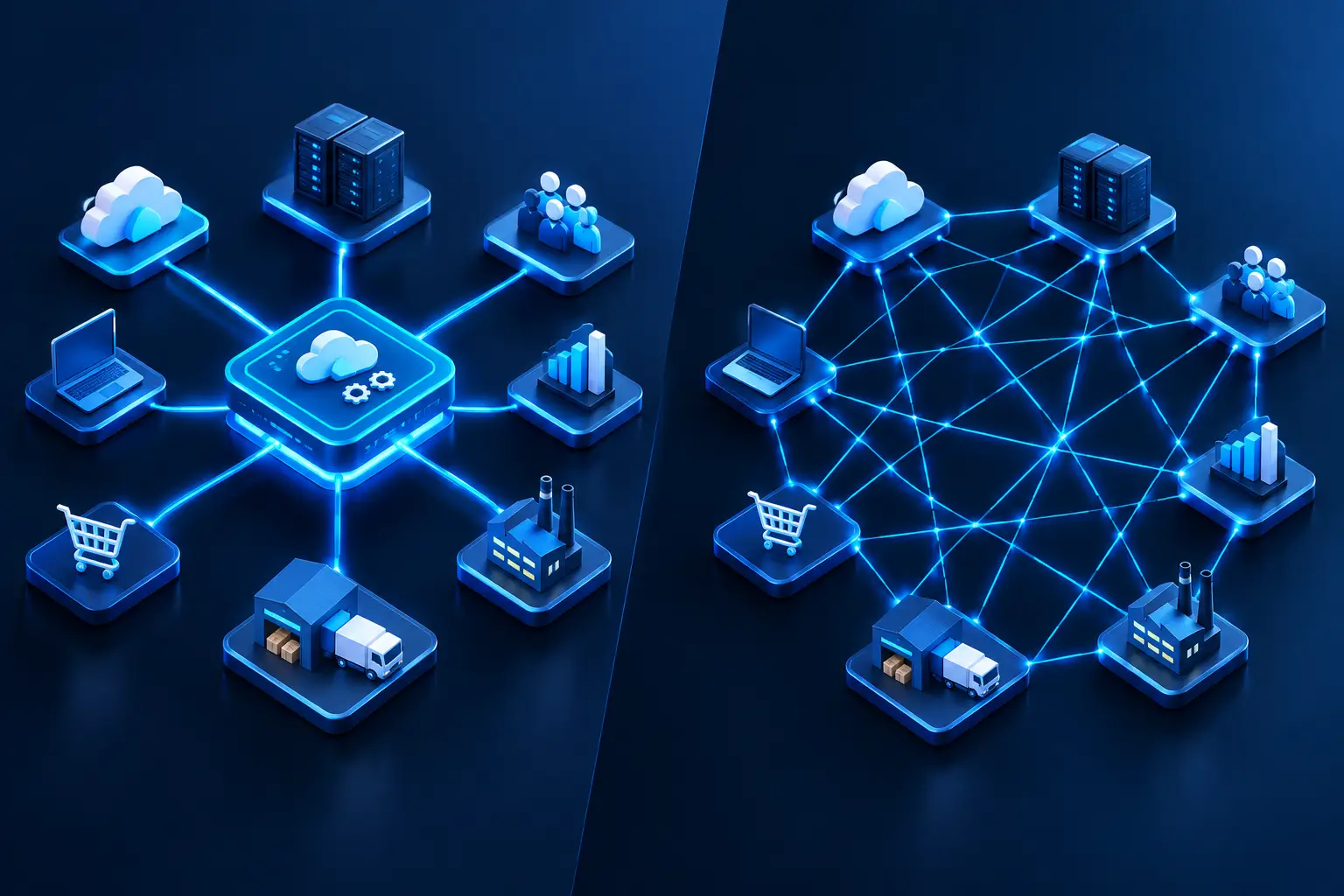
Point-to-point integration occurs when two systems communicate directly with each other. For example, the online store sends order data to the ERP, and the ERP forwards inventory information to the online store. Each connection can operate with its own rules, data format, authorization management, and error handling.
This approach is not flawed; in fact, it is often the most sensible choice. If a company has a single online store, one ERP, and a clearly defined data exchange, the direct connection can be quickly implemented, easily understood, and cost-effective. There is no need to build a central integration layer just because it seems technologically more elegant.
The problem starts with the increase in the number of connections. If the same ERP is connected to an online store, CRM, warehouse system, shipping company, supplier platform, BI system, and customer portal, each new connection creates its own dependency. Modifying an ERP data structure is not just a development task but requires coordinating multiple systems and business processes.
In the point-to-point model, it is common for the same business rule to appear in multiple places. Transforming order statuses, cleaning partner data, or mapping item master fields can be included separately in each integration. This not only means additional development work. Later troubleshooting is also slower because the company must first understand where the discrepancy originated.
What does an API gateway provide?
An API gateway is a central entry and regulation layer for communication between systems. Instead of each application accessing all other systems directly, external and internal requests pass through defined, supervised routes.
In business terms, this means the company manages not a collection of separate technical connections but establishes the order of system communication. It can be determined who can request what data, in what format, at what frequency, with what authorization, and with what logging. A new partner interface or mobile application does not need direct access to the internal ERP just to see inventory or order status.
The gateway is particularly valuable where access and operational security are business risks. Authentication, authorization, traffic limitation, logging, and error monitoring can be managed centrally. If an external system erroneously repeats a request, it does not overload the internal system indefinitely. If a partner's access is terminated, there is no need to search for their authorizations in multiple separate connections.
It is important to note that an API gateway does not necessarily solve all integration tasks. It is not an automatic data quality improvement tool, does not replace the clarification of processes, and cannot decide which system should be the official source of data. If customer data differs in the CRM, ERP, and an old customer registry, the gateway can only forward the discrepancy in a more organized manner.
API gateway or point-to-point integration: the real considerations
The right answer is not that every connection should be centralized. The right answer fits the complexity, pace of change, and risks of the company's processes.
Point-to-point connection is generally justified if the data exchange is simple, remains between two systems, changes infrequently, and there is no sensitive external access. In the case of a narrowly defined data set transferred daily by a production machine or a unique carrier label printing connection, direct integration can be a well-documented and reliable solution.
The situation points towards an API gateway if the same services are used by multiple systems, partners, or channels. A typical example is when the online store, customer portal, and sales application all request order status, inventory, or customer data. In such cases, it is not business-wise for each to align directly with the internal operation of the ERP. It is more practical to establish a stable, regulated service interface, behind which the internal system can be modified later.
The cost of change is also a decisive factor. A direct connection may initially seem cheaper. But if each new channel requires separate development, security checks, and troubleshooting, the short-term simplicity can be expensive in the long run. In contrast, introducing a gateway requires more planning and a more disciplined architecture initially. It pays off when the company has to manage not just a single connection but repeatedly new connections.
First, ensure data and process clarity
Many integration projects falter because technical questions precede business clarification. Before deciding on the architecture, it is worth following a specific process: what happens from order receipt to delivery, who can modify the data, where new information is generated, and in which system the data becomes final.
For example, if the warehouse uses the ERP's inventory, but the online store shows availability according to its own rules, it is not a technical detail which data is visible to the customer. This directly affects orderability, customer communication, and the number of complaints. Integration will only be reliable if these responsibilities and business rules are clear.
The same applies to error handling. What happens if the invoicing system is temporarily unavailable? Does order processing stop, does the data go into a waiting queue, or does someone try to manually compensate? Who gets notified, and when is an error considered resolved? A functioning integration is not good because it sends data in normal situations, but because it remains controllable even in abnormal situations.
Gradual organization is often better than rebuilding
In a growing company, it is not realistic to expect all existing connections to be redesigned at once. Moreover, a major overhaul of integrations supporting critical operations can pose significant business continuity risks.
It may be more reasonable to first map the connections: what data is moved by which, who uses it, how critical it is, who is responsible for it, and whether there is up-to-date documentation. This work alone can reveal that a single employee knows why an old data transfer runs, or that the same information moves between two systems in parallel with different rules.
Then, it is worth starting with the areas that provide the most value. It may be justified to establish gateway-based access for a new customer portal, while two old, stable internal connections remain direct for now. The goal is not to follow a technological pattern but to gradually improve control, maintainability, and adaptability.
A good system architecture is ultimately valuable not because of the number of modern components it includes. It is valuable because the path of an order, inventory data, or invoice is understandable, controllable, and remains operational even when the company's next growth step arrives.
Planning a similar system or integration?
Show us the current process and systems. We will help identify the lowest-risk next step.
Key Takeaways
- API Gateway provides a centralized entry and regulation layer for system communications, ensuring controlled and monitored pathways for requests.
- Point-to-point integration involves direct communication between two systems, each with its own rules, data formats, and error handling.
- Choosing between API Gateway and point-to-point integration depends on the specific needs and long-term goals of the enterprise.
Frequently Asked Questions
What does point-to-point integration mean?
Point-to-point integration refers to direct communication between two systems. For example, an online store sends order data to an ERP, and the ERP forwards inventory information back to the store. Each connection operates with its own rules, data formats, authorization, and error handling.
What does an API Gateway provide?
An API Gateway acts as a centralized entry and regulation layer for communication between systems. Instead of each application directly accessing all other systems, external and internal requests pass through defined, supervised routes.
Related Engineering Insights
How to Manage Supplier Product Feeds?
How to manage supplier product feeds so that the webshop, inventory, and sales work securely from the same verified data.
Who is Responsible for Data Quality in System Integration?
Who is responsible for data quality in system integration? The answer is not a single role: it requires clear responsibility, process, and control.
B2B Client Portal Design Guide in 8 Decisions
B2B client portal design guide for growing companies: processes, permissions, and integrations for reduced administration and improved corporate operations.